Uganda’s financial sector met on 21 October 2026 to agree how the country will define a women’s business.
Closing the financing gap for women starts with a concrete, measurable definition of which businesses count as “women-owned” or “women-led”. In many markets this question is still open, and agreeing on a single harmonized definition of a women-owned or women-led micro, small and medium enterprise (WMSME) is therefore one of the first activities countries take on when they adopt the Women Entrepreneurs Finance Code (WE Finance Code). With over 30 countries adopting the Code and a target of 90 Code countries by 2030 (We-Fi, 2026), We-Fi and partners like ConsumerCentriX are helping to close the financing gap and starting with clear data and definitions.
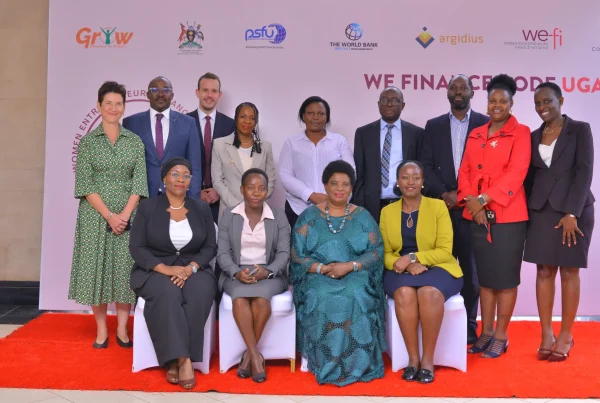
In Uganda, ConsumerCentriX (CCX) and the Private Sector Foundation Uganda (PSFU) supported the financial sector to agree on a definition as part of the country’s implementation of the Code, with the Bank of Uganda (BoU) leading the efforts, in collaboration with the Uganda Bankers Association (UBA) and the Association of Microfinance Institutions of Uganda (AMFIU). A survey of FSPs, issued through PSFU, mapped how institutions serve women’s businesses and which definitions they apply, and on 21 October 2026, the Bank of Uganda (BoU) hosted a workshop in Kampala, organised by ConsumerCentriX in partnership with PSFU, where the sector came together to agree one.
More than 100 participants from 52 institutions took part, among them 38 financial institutions, 20 of the Code’s 23 signatories and 18 institutions that have not yet signed, alongside ministries, regulators and sector associations. Participants voted unanimously that Uganda’s definition should rest on ownership and confirmed that micro enterprises fall within its scope. The day’s technical sessions were facilitated by ConsumerCentriX, covering the survey findings and definition practice in other Code countries, followed by two interactive sessions in which participants settled the approach to the definition and set up the Data Working Group. The precise threshold, including how to treat businesses owned equally by women and men, now passes to a Data Working Group chaired by the Bank of Uganda, launched at the workshop alongside a second group on what institutions offer women entrepreneurs.
How should WMSMEs be counted?
The Code guides countries in developing their own, contextual definitions, with countries being asked to set one harmonized definition that is aligned with international practice for all signatories (We-Fi, 2025b). The international reference point (ISO, 2021) describes a woman-owned business as more than 50% owned by one or more women, with women in management and control and as signatories of its legal documents and financial accounts (Open Contracting Partnership, 2021). Countries then set their own thresholds: for example, Egypt counts 51% ownership, or 20% ownership with a woman CEO or deputy, while Jordan applies a looser 25% ownership threshold combined with board representation, management or signatory power (We-Fi, 2025c).
However, even where a country has set a definition, it is not always applied uniformly, and regulators and FSPs often work with different sets of criteria. What determines whether a business is considered women-owned or women-led can depend on ownership share, who leads the company, board membership, or some combination of these, and the choice can change the defined size of the market considerably. When Jordan tested its new national definitions on 128,764 registered businesses, about 18% met the women-owned test (51% ownership with signatory power), while only about 2% met the women-led tests (GIZ, 2025), showing that the same economy can present a women’s market of one business in six or one in fifty depending on where the line is drawn.
For an FSP, unclear criteria become a commercial problem. A woman-owned or women-led business that falls outside the provider’s own definition never enters the proposition built for her, so she is usually served a generic offer, and the provider may miss that part of a market it believes it is already reaching. For a regulator, it becomes a data and reporting problem. If one provider counts a business as women-owned at 51% ownership while another applies a different threshold, the figures cannot be added up, leaving no reliable baseline and no visible trend. This in turn becomes a policy problem, as interventions designed for women entrepreneurs may not reach the businesses they were meant for, and there is no dependable way to tell whether they are working. As Milly Nalukwago Isingoma, Director of Statistics at the Bank of Uganda, put it in her opening remarks at the workshop, “We cannot improve what we cannot see.”
Setting definitions as a sector
While a definition in law is strongest, it only works if FSPs can apply it with the data they already record. Banks typically capture the gender of owners and managers at onboarding, along with ownership shares, and can check them against business registries; criteria that depend on information they do not collect tend to remain on paper. The case of Dominican Republic shows how this can work in practice. In the DR, the 14 signatories each classified women-owned businesses by their own criteria until the banking association (ABA) surveyed the definitions in use and put several options to the Code’s Data Working Group, which voted on one at its next meeting: 51% or greater women ownership or control, with size categories aligned with national MSME standards (We-Fi, 2025a, p. 8). Since it was the definition most signatories were already applying, it was then more easily adopted without rebuilding how clients were classified.
Uganda arrived at ownership the same way.That survey, covering 31 institutions, 13 banks, nine microfinance and deposit-taking institutions and nine SACCOs, found that three in four already had a definition of a women’s business and most based it on ownership. Every institution recorded the gender of sole owners, while only 23% collected any identification for managers. An ownership test therefore asked the fewest institutions to change how they work.
An ownership definition of this kind had already been operating at national scale. Under the World Bank-funded GROW project, which PSFU co-implements with the Ministry of Gender, Labour and Social Development, finance reaches women entrepreneurs through 14 participating financial institutions (Watchdog Uganda, 2026) under a women-ownership test of at least 51% of a business’s shares held by one woman (GROW, 2025).
The Data Working Group meets for the first time in early November, with the ownership threshold, harmonised size categories and data sharing with the Bank of Uganda as its opening agenda. The definition is expected to be endorsed at theUganda WE Finance Code Anniversary Event on 23 November. Once it is, lending to women-owned MSMEs can be measured against a segment the whole sector counts the same way.