


What Post-COVID Survival Could look like for Ugandan Tourism Business
ConsumerCentriX is partnering with Stanbic Bank Uganda on the Covid-19 Business Info to provide to entrepreneurs across Uganda with reliable information to help them overcome the challenges of the pandemic. A version of this article was originally posted on the COVID-19 Business Info Hub.
The COVID-19 Business Info Hub spoke with David Gonahasa, an African tourism enthusiast and CEO of Tripxio, an SME that has built a unique solution to help tourism businesses survive through the serious effects of the COVID-19 pandemic. Here are some of the lessons SMEs in the sector can learn from to ensure their survival post-COVID.
What have the effects of COVID-19 been on the tourism sector?
From the onset, 2020 screamed opportunity for Uganda tourism. The year on year growth trend was expected to continue, and operators were looking to drive sales as high as possible in anticipation of a possible slowdown caused by 2021 being an election year.
Four months into the year, the entire tourism sector, which contributes 7.5% of GDP, shut down due to COVID-19. The largest hotel chains have laid off staff, some operators are completely bowing out, and according to Uganda Tourism Board, about 460,000 jobs are on the line. The lockdown will soon be over, and people will travel again; however, for some operators, the damage may be irreparable. It could be up to a year before international tourists, who have long been the core backbone of the sector revenue, start to flock Uganda again. Without these visitors, operators that start over will still be in the eye of the storm and will have to be at their most innovative to navigate this period.
What does survival look like?
Sector specialists expect that tourism will restart with domestic and regional market bookings and that eventually international tourists will return. This brings up questions around how to target the domestic market and whether the market is sufficiently large to keep the sector afloat. Targeting domestic and regional tourists may be a viable option for operators to not only create cash flows post-COVID but also start to rebuild destination confidence, particularly since most people (including international tourists) will travel to places where other people go.
Is the market sufficiently large? Yes. The African Development Bank reports Uganda’s middle class makes up 18% of the population, which is about 7.2 million people. The same report places the upper-middle-class number at about 1.5 million individuals. This would indicate that there are over 1 million Ugandans likely to be able to afford to pay for tourism or experience-related products, as well as groups like schools and churches.
What is important is changing the mindset around domestic or regional travel and finding new ways of communicating customer experience. Local tourism operators have long been reluctant to focus on the domestic market with the viewpoint that “Ugandans don’t travel.” This view is now gradually changing to “Ugandans prefer to travel to international destinations as opposed to local National Parks.” Data from Dubai Tourism and Commerce Marketing (DTCM) that indicates that 49,000 Ugandans traveled to the Emirate in 2018 may confirm this view when taking into account that this is larger than the number of East African Residents who traveled to most Ugandan National Parks in the same year. The value to the potential domestic or regional tourist traveling to a Ugandan National Park needs to be effectively communicated – and that means highlighting things like price, convenience, scenic beauty, and the customer experience that can be expected. Marketing should focus on being empathetic and relatable – it is not the time for “come to my destination” type marketing. The #TravelTomorrow campaign is one to ride on.
How can industry players practically re-invent themselves post-COVID?
In more developed markets, tourism is highly fragmented and specialized. Products are tailored to suit the target audience’s needs and desires. This innovation creates differentiation and relevance for operators. It drives consistent bookings. In Uganda, tourism is still characterized by product homogeneity, Operators sell the same National Park deals, for the same number of days, and in many cases, even for the same price. For competing operators, conversion comes down to how much an agent has to spend on marketing or how well networked they are.
A few recommendations to consider include:
Rethink and redevelop products.
Operators should:
- Identify their target customers. Who are operators selling to?
- Understand their motivations to purchase tourism or experience products. Are they looking to relax? To engage with culture and history?
- Build products around that, ensuring that what are you selling and why they should buy from you are clear.
Rethink distribution & digitalize business operations.
With an effective technology solution, an operator can start distributing packages and promotions for later dates, accept installments, and start to guarantee revenues. Business survival calls for improving efficiency across many areas, primarily product distribution, conversion, and maximizing customer spend. Digitalizing tourism sales and operations is one way to achieve this, enabling front end e-commerce and back end operations capabilities.
Digitalization has for long seemed very expensive and out of reach for many operators; however, there are a number of solutions today that will allow an operator to achieve this at a fraction of the cost. Tripxio (hello@tripxio.com) is one such solution that helps businesses develop, distribute, and sell tourism and experience products online. It allows businesses access to e-commerce websites, itinerary builders, digital marketing, and bookings and payments systems, and generally enables them to manage back-office operations and customer relationships all in one place. This solution is a software as a service model, which implies a limited cost of acquisition to the business with the benefits of running an in-house technology team.
Get creative about marketing and public relations.
Marketing and public relations activities should not stop for agents, even if travel is limited. It is pertinent to remain visible and use this time to build customer expectations. Marketing should focus on being empathetic and relatable – it is not the time for “come to my destination” type marketing. The #TravelTomorrow campaign is one to ride on. Communicate what your business is doing to be better post-COVID and what inclusive tourism strategies are being implemented to ensure sustainability not only for the business but also for nearby communities. Answer questions like “What is the business story? Why does it matter?” As the lockdown is loosened and people start to travel, show that people are coming to your destinations. This will drive confidence, and more visitors will come. If you are unsure of how to craft this kind of messaging yourself, there are numerous communications professionals out there that can support this process.


COVID-19: Challenges, coping mechanisms, and urgent needs of SMEs in Uganda
ConsumerCentriX recently interviewed entrepreneurs in Kampala, to learn about their current challenges, coping mechanisms, and urgent needs in the midst of the COVID-19 pandemic. Below are some highlights from those conversations.
Local measures impacted most entrepreneurs
- Lockdown, shutdown, and social distancing are top of mind measures for all entrepreneurs. The direct consequences of these measures include a drastic decline in daily sales, an increase in the price of goods, and a reduction in the supply of those goods, which has resulted in loss of revenue for most.
- The reduction in revenue has additional consequences, including difficulties to pay business rent, bank loans, suppliers, employee salaries, and family expenses.
- COVID-19 has affected the entire value chain, from suppliers being unable to deliver on existing orders or contracts due to logistical challenges to wholesalers and retailers that stocked up when the pandemic was first announced, and now many are suffering for not generating enough income to pay back to suppliers.
SMEs’s coping strategies
- SMEs in Uganda are using a variety of different strategies to avoid permanent closure, including keeping in close contact with suppliers, placing and accepting orders via phone, delivering products by motorcycle, and even using their personal Facebook accounts to market their products or services.
- Other SME owners have downsized, temporarily closed, reduced the number of employees or laid off employees. They stopped stocking up general goods, and have instead focused on stocking fast-moving goods. A number of them based in Kampala have also decided to send their families to their home villages to work in agriculture as a way of diversifying income and reducing family expenses.
- Some are also suspending payments on bank loans or withdrawing funds from their savings accounts (in many cases, these funds were meant to pay for school fees) to save their businesses from being evicted.
What SMEs urgently need
- To survive this crisis, SMEs need urgent flexible and affordable financing and non-financial support to help them to become more resilient and adapt to the new market conditions.
- While optimistic by nature, entrepreneurs would benefit from building their skills in things like how to keep in touch and negotiate with their suppliers; how to communicate with and deliver to their customers; how to digitalize their businesses; and how to manage their operational expenses such as employee salaries. An equally important topic would center around how to keep mental well-being in these times of crisis.
Meet the Business Info Hub
In this context, ConsumerCentriX in partnership with Stanbic Bank recently launched the COVID 19 Business Info Hub, a platform designed to help entrepreneurs navigate the changing environment.
The Business Info Hub provides entrepreneurs with insights and tools to better manage their businesses. In partnership with the African Management Institute (AMI), entrepreneurs can also access a suite of programs through their COVID-19 Business Survival Bootcamp, ranging from cash-flow forecasting to adjusting products or services for new customer segments, and from repurposing existing assets to meditation sessions that help promote mental well-being.
We invite you to explore the https://covid19businessinfohub.com/ to find the tools most appropriate for your own situation. And if you don’t find what you need, just let us know so we can try to find the best way to help you!
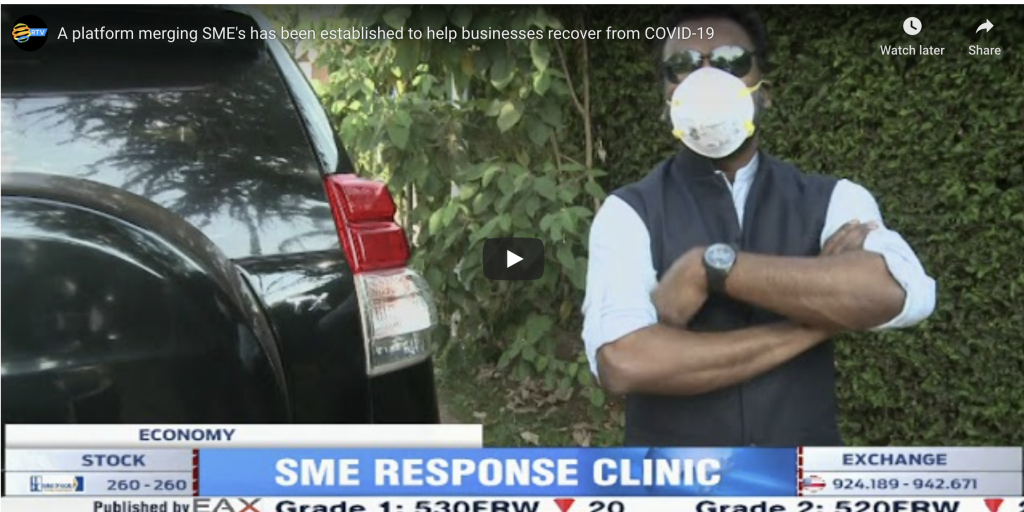
The SME Response Clinic is featured by RwandaTV
The SME Response Clinic is featured by RwandaTV
ConsumerCentriX is proud to partner on the SME Response Clinic with Access to Finance Rwanda and Rwanda Private Sector Federation
Nothing found.

CNBC NEWS |Rwandan entrepreneurs treated to Covid-19 business survival boot camp
Rwandan entrepreneurs treated to Covid-19 business survival Bootcamp
Access to Finance Rwanda in partnership with the African Management institute, the Private Sector Federation and others, has launched a new webinar series dubbed, ‘The Business Survival Bootcamp’, through their website, SME Response Clinic. The program is designed to help entrepreneurs navigate the unique challenges that have presented themselves as a result of the Covid-19 pandemic and is slated to begin next week. Head of Programs at AFR, Jean Bosco Iyacu joins CNBC Africa for more.
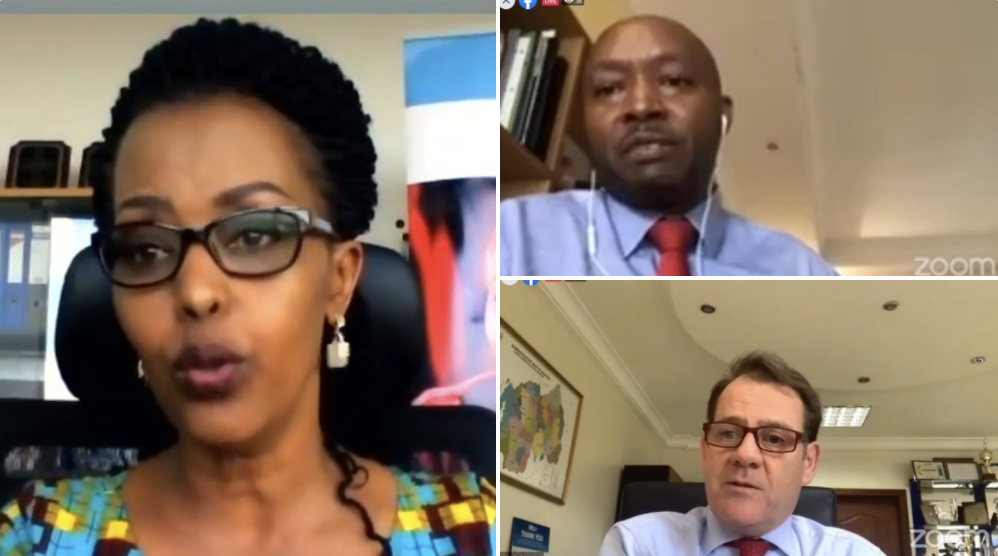
Supporting Your Business Series: Advice from the Banking Sector in Rwanda
Supporting Your Business Series:
Advice from the Banking Sector in Rwanda
A version of this article was originally posted on the SME Response Clinic
Improve your business management skills with AMI’s free Bootcamp and Trainings:
Bootcamp: Thursday, June 5th, 2020 – https://www.africanmanagers.org/rwandacovidwebinars/
Open Webinars: https://www.africanmanagers.org/covidwebinars/
Many SMEs have questions about banking services right now, given that businesses have faced low cashflow, difficulty in repaying loans, and uncertainty. In response, the SME Response Clinic brought together a panel of bankers for a Facebook Live Event.
On May 28, this live webinar entitled “A Discussion with the Banking Sector” kicked off the Supporting Your Business Series. The interactive session engaged banking experts Maurice K. Toroitich, Managing Director of BPR Atlas Mara, Robin C. Bairstow, CEO of I&M Bank and Chairman of Rwanda Bankers Association, and Christine Baingana, CEO of Urwego Bank. It was moderated by Tony Francis Ntore, Executive Secretary of the Rwanda Bankers Association, and Jean Bosco Iyacu, Director of Programs at Access to Finance Rwanda.
Bankers offered advice to SMEs on managing businesses and relationships with their financial institutions. Here are the top recommendations to help your business survive the pandemic:
One of the main mistakes banks see small businesses make is using one account for both business and personal funds. When you start a business, it is important to open a separate business account so that you can track your earnings and expenses in an organized way. A good rule is to pay yourself a salary, but to pay it from your business account into your personal account so that you have a clear idea of your cashflow.
Keeping separate accounts will help you to better understand your own business’s profitability and will help if you decide at some point to access credit from a formal institution.
The COVID-19 pandemic has brought many changes to the business climate in Rwanda. Those businesses that learn to be flexible, to assess the effect that the crisis has had on their businesses, and who learn to plan three to six months in the future will be best placed to survive.
One important piece of advice from bankers is for businesses to plan for a much different market than they experienced in the past. For example, if a business made a certain revenue pre-COVID, they should not assume that this will go back to normal after the crisis has passed. Planning for a different customer base, and for reaching new customers will be key. Some businesses may move online, or adapt a model with more delivery services, for example.
Another thing to keep in mind is that now is not the time to venture into a completely new business line. Trying to start a new business in a new market is one of the riskiest propositions during a difficult time. While there will be changes and modifications in existing businesses, trying to take on a new venture without the knowledge of the business, good or service, and without the capacity to run that new venture, may lead to failure. It is important to first ensure that you have the knowledge and capacity for a new venture before seeking capital from a bank. If you cannot demonstrate this, you are likely to be disqualified.
Learn more about keeping accurate records with AMI’s free Bootcamp and Trainings:
Bootcamp: Thursday, June 5th, 2020 – https://www.africanmanagers.org/rwandacovidwebinars/
Open Webinars: https://www.africanmanagers.org/covidwebinars/
To keep you, your staff, and your clients safe, new digital solutions can be used in place of cash. Currently, there are zero fees when you transfer from a mobile wallet to a bank account, transfer between mobile wallets (person to person transfers), pay a merchant with mobile money, or pay your bills with mobile money. There are also no fees when you make a payment at a merchant with a card via a point-of-sale (POS) device.
These digital solutions help not only in avoiding touching cash, but they also help to keep solid records of your business cashflow. It is important to keep separate wallets or digital accounts for personal and business transactions so that if you need to access a loan or other solution from a bank, you can clearly show these records as proof of your creditworthiness.
For current clients, banks have developed a number of services to help repay loans. These include grace periods on interest and principle, other deferments, and waiver of late penalties and fees. Banks understand that many SME businesses are experiencing a decline during the lockdown.
Talking to your bank – to your relationship officer or loan officer – is key. If you are having trouble do not wait, do so right away. The bank will work with you to decide the time period needed for grace periods or deferments, often depending on the sector you are in and how hard it has been hit.
On June 4, 2020, the National Bank (BNR) has launched the Economic Recovery Fund, a fund which will allow banks to offer discounted loans and other services to businesses struggling due to the crisis. However, it is important as a business to plan carefully about your capacity to borrow and to earn enough to repay your loan. Even though loans will be available at lower interest rates for qualifying borrowers, they are not a grant. These loans will come with the same terms and conditions as a normal loan – to repay in full, on time and with all applicable fees and charges.
If you do qualify, and have a clear plan for how you will use and repay the funds, you may learn more by talking with your relationship officer or loan officer. They will help to make sure that you have all of the paperwork needed, that you have been a responsible client in the past, and that the loan will be a help rather than a burden for your business.
Learn more about assessing your capacity to borrow with AMI’s free Bootcamp and Trainings:
Bootcamp: Thursday, June 5th, 2020 – https://www.africanmanagers.org/rwandabusinessbootcam
Open Webinars: https://www.africanmanagers.org/covidwebinars/
Banks find that sometimes clients will use the loan funds that they have received for something other than their business, and when it comes time to repay, they no longer have the money. This is the number one reason that banks lose confidence in a customer. While it seems like a good idea in the short term, it will affect your ability to take out loans in the future, especially now that defaulting on a loan will affect your credit rating with the Credit Reference Bureau.
Rather than diverting funds – even if you have a crisis – as always, you should talk immediately with your relationship officer or loan officer. Your bank is not there to judge you but to help you. Without clear, truthful, and up-to-date information from you, they will not be able to discuss your problem and come up with a solution that will avoid you falling into default.
Many business people ask themselves: “Why should I get insurance and spend money that I will not see again if I do not experience a problem?” However, insurance is one of the most important products that a business can purchase to help manage risk. One rule the bankers offered is that if you cannot afford an insurance premium, then you cannot afford to not be insured.
In the case of an emergency – theft, a fire, an automobile accident – you need to protect the assets and infrastructure of your business. Insurance is available through financial institutions as well as through insurance companies to help you protect yourself against unforeseen events and avoid losing your livelihood.
The relationship between a business and its clients and customers cannot be ignored, even when the business climate is difficult. You have got to stay in contact with both customers and suppliers so that they know what you are doing to continue your relationship once business begins to pick up again.
For example, many small businesses struggle to pay rent or other suppliers because revenues were low or nonexistent during lockdown. While suppliers do not look forward to losing revenue, many are open to negotiation so that rather than losing ALL revenue, they still are able to make some earnings.
In terms of customers, you may not be able to supply goods and services in the same way that you could pre-COVID. You may need to negotiate with those who have paid in advance or reassure customers that you have a plan to reopen and will be working again as soon as possible. The key is to keep the lines of communication open so that your customers do not seek another business who is willing to speak with them and value their business.
Learn how to negotiate with suppliers with AMI’s free Bootcamp and Trainings:
Bootcamp: Thursday, June 5th, 2020 – https://www.africanmanagers.org/rwandacovidwebinars/
Open Webinars: https://www.africanmanagers.org/covidwebinars/
ConsumerCentriX is a Proud Co-Sponsor of this Event

How is PSFU engaging its members and government to support businesses through the COVID-19 crisis?
How is PSFU engaging its members and government to support businesses through the COVID-19 crisis?
To provide the much-needed information and solutions for Ugandan entrepreneurs struggling with the financial consequences of the pandemic, Stanbic Bank has partnered with ConsumerCentriX on the Covid-19 Business Info Hub. This interview originally appeared under “insights for my business” section of the hub.
The COVID-19 Business Info Hub spoke with Francis Kisirinya, Deputy Executive Director of Private Sector Foundation Uganda (PSFU), about the ways in which PSFU is engaging its members and government to support businesses through the COVID-19 crisis.
Our role as PSFU to support businesses is three-fold: first, representation and engagement with government; second, building and supporting businesses to be able to do their business better; and third, mobilizing resources to address the challenges they face.
What advocacy efforts is PSFU undertaking to support SMEs during this time?
PSFU has been and continues to be actively engaged in discussions with the government on issues critical to businesses in the private sector including ensuring timely payments by the government to suppliers, supporting the financial sector in relaxing loan repayment requirements for some borrowers, supporting businesses in maintaining liquidity and accessing affordable finance, and highlighting the importance of business development services. Proposals PSFU has made are already being adopted [by government], and [PSFU] is optimistic that additional suggestions will soon be implemented.
How does PSFU support businesses directly?
It is very clear that business owners need to enhance digital skills. From a policy perspective, PSFU is proposing things that can be done to improve infrastructure and internet availability across the country. On the side of business owners, PSFU offers support with publicity as well as skills building for employees as they work. MSMEs trading today need to include a digital delivery channel. Companies interested in participating in training are encouraged to respond to PSFU’s calls for proposals.
How can businesses engage with PSFU?
PSFU Services is found on Plot 43 Nakasero Road Kampala
Call us on: +256312263850
Email: klmusoke@psfuganda.org.ug
Twitter: @psfug
Facebook: Private Sector Foundation Uganda (PSFU)
Skills Development Facility email contact: dmugoya@psfuganda.org.ug
Q: Introduction
My name is Francis Kisirinya. I am the Deputy Executive Director of Private Sector Foundation Uganda. My day job is to ensure that I am able to link the private sector to policymakers and able to help them improve any issues they have via our programs. We support their capacity building and mobilize resources to support the private sector in Uganda. PSFU has 250 members, which are groups that come from and cover sectors like manufacturing, education, hospitality, insurance, banking, agriculture, mining, trade, commerce – every part of the economy is represented. Those are the direct members. Indirectly, if you look are those organizations and the members under them, we have almost 50,000 businesses indirectly represented and engaged by us.
Q: What is PSFU’s role in support to the private sector and SMEs in particular?
Our role as PSFU is three-fold: first, representation. We represent MSMEs [Micro Small and Medium Enterprises] in places where they are not located. For instance, not all of our traders in markets and shopping malls will be sitting down with government to discuss policy. We have a mechanism through which we reach the members, through the organizations that they are members of. We represent them in government, in terms of policy making. We conduct research and look at policy options and engage with government to discuss policies that will aid their businesses. The second mandate is to build and support businesses to be able to do their business better. You need skills, capital, technology, and so on and so forth. It is our role to be aware of these things and ensure that you benefit from them, that you build your capacity to be able to compete. We also are required to mobilize resources to address your issues. For instance, the country has substantial competitiveness challenges, both at the national level and among our businesses. We look out for resources to help businesses deal with issues affecting their competitiveness. If you look at manufacturing, for instance, they face issues in terms of technology. As PSFU, we can intervene in this area to identify funders, providers of those types of technology so businesses can identify and implement this technology to be able to compete with everyone doing business in the country.
Q: What considerations does PSFU have for smaller member groups such as SACCOs?
For smaller member groups such as SACCOs, we have a two or three track arrangement. First, they must be our members. As members, they are able to discuss and bring their issues [forward]. We bring you together so that you are able to network and work with others. The second thing is that we work with small enterprises in increasing their ability to do their businesses better. One of the things that is a big challenge for SACCOs is in terms of access and utilization of technology. Today’s consumer wants to trade on their phone, banking on their phone, access loans on their phone. Many SACCOs do not have this particular capacity to access this technology. PSFU is actively engaging with providers to make sure SACCOs can access things like this. We are also actively engaging with the government to make sure that SACCOs are able to have some resources that are affordable to on-lend to members of the SACCOs.
Q: What has the impact of COVID-19 been on the SME sector?
PSFU has grouped the impact into three areas; the first one is the markets. Because of the various decisions and new standard operating procedures that have been instituted (such as social distancing), businesses’ access to markets have been curtailed. People are not able to go shop. Those who shop and those who do the trading themselves have not been able to go [to markets]. This is also true for those exporting goods. Those exporting goods are also affected. It is also true for those obtaining supplies, whether locally or through the international community. They are not able to access these particular markets. This has a lot of implications down the roads because activity has been reduced while fixed costs have not been reduced. You pay rent whether you are working or not. The second area of impact which we have seen is the drying up of cash. Companies do not have cash anymore. Very few people are coming [to do business]. Your employees need the cash, financiers who have provided you financing need the cash, you also need the cash. There is very little cash. This is causing a lot of challenges for a number of MSMEs. The next area is in terms of being forced to work in different ways. We are seeing a change in the kind of demands that consumers are putting on MSMEs. Consumers are requiring that MSMEs put in [place] safety measures. As an MSME, you have to invest in safety, address this and invest in personal protective equipment. This is affecting these businesses seriously. Many businesses are facing substantial losses at this time.
Q: Do you have any indicative numbers on where the greatest impact has been?
For the tourism sector for instance, the impact has been 100%. The sector is totally closed down. There are probably 30,000 employees that are home. In the export sector, they are also reducing staff significantly. In manufacturing, they are doing some minimal work, but it is impossible for them to do what they were doing before. Many are reducing staff counts by about 30% in the manufacturing sector alone. In trade, many are not working. These are all jobs that have been lost.
Q: What plans for advocacy does PSFU have in mind to support SMEs?
From the perspective of advocacy to ensure MSMEs are supported, we have been engaging with the government over the last few months and highlighted to them a number of things that they can do. The first is in dealing with issues of liquidity. We have proposed that the government should pay all people who have supplied it goods quickly. There is an issue in the government of sometimes purchasing goods but not paying quickly. We have asked that they make these payments. We supported MSMEs and requested that they submit to us all of their claims. By April 20, we submitted a list with over 1 trillion shillings in terms of unpaid bills, and the government agreed to make these payments. I will also recommend that the businesses, the MSMEs, pay their suppliers if they have some cash. Pay your supplier, pay your employees. That also helps. The second thing that we’ve asked the government to help with is to see that companies’ tax refunds are released. The Uganda Revenue Authority has provided guidance on how to make these refunds much quicker, so they have responded. We have also requested that the financial sector relax the loan repayment requirements with some of their borrowers. The Bank of Uganda has given very good guidance on this in terms of suspending payments, moratoriums on payment of interest, restructuring loans. All those have actually been done, and the government and Bank of Uganda have advised the government that for some requirements that were previously needed before a loan could be restructured, they be waived – even if a loan is in arrears, present yourself to the bank, and the bank will be able to advise you and you can then move forward. The third area we have done on advocacy is to advise the government not to consider increasing taxes. We also wanted some to be reduced so that businesses have some more liquidity to work with. We have advised incentives that were done a few years ago, such as investment incentives, be reinstated so that some companies with extra cash can invest. The fourth area where we have asked government for support is in terms of building alternative markets and access to those markets. We know that today markets in Europe, Asia, and the Middle East are facing challenges because of this virus. We need to find alternative markets, or if not alternative markets, new consumers in these markets. We ask that they make sure consumers still have Uganda in their minds so that when the whole world opens again, they come back for tourism and they continue to buy goods from Uganda. We have also asked that government focus strongly on enterprise development. We need to ensure that we create and build enterprises that are sustainable. The biggest piece of that is providing financing that is affordable but also long term. We insisted that the Ugandan Development Bank be recapitalized so that it is ready to lend out to the MSMEs, to the private sector. When there is affordable finance, we will see investments into MSMEs and MSMEs being more resilient than they are today. We also know that business development services are so critical, so crucial. MSMEs sometimes fail to pay their loans purely because of the additional things that they should have done but do not do. This includes financial literacy and proper preparation of a loan proposal. Business development services is a very important thing that we have asked government to pay attention to so that when businesses come back and access financing, they are able to be resilient and are not affected by things like this virus. We have also requested that the government look at insolvency law, not only in terms of how to organize it and prepare a company that has failed, but it should now have a component of reinvestment. Meaning if a company is insolvent its commitments, don’t just move to sell it. Allow and rehabilitate it. You might need to reinvest in it – reinvest in it and bring it back. In many countries, this facility exists, and they are saving their companies. This is how you have companies that have been in existence for hundreds of years. As we engage government and tell us what they should help us with, we also have our own responsibilities, our own tasks to do. We have learned that we have to have savings. We have to look very closely at what we are spending. We must reduce and optimize costs so that we save for a rainy day. Try to learn how to work with insurance services, understand social safety nets. How can we engage with them? Are they being run properly? If you have an insurance policy, savings, a network of support systems, you are more likely to come back. The other thing that we have talked about very strongly is that government should look at alternative ways of accessing markets. For instance, there are markets for exports in Europe and North America for which we do not have cargo transport capability. We also have to look at how to trade in other markets for Uganda where there are concerns about not being paid. The government needs to support us in trading in some of these markets. We need things like insurance coverage for this. We have connected very well with the government and are quite happy that we are all aiming towards improving and saving our economy.
Q: Will these proposals be adopted by government?
As you can see, a number of these proposals are already being adopted. On the banking side, you can see things being done. The other day the President wrote about securing money to support production. You have seen URA helping the administrative procedures for tax refunds. In the [national] budget, no taxes are going to be increased. There were proposals for increasing taxes this year that are now not there. We will get some room to build ourselves back. The other proposals that we have made are under discussion, and the discussion is going very well. We are very optimistic that the suggestions that we have made are going to be implemented.
Q: What solutions does PSFU have towards training entrepreneurs on digital trading and working remotely?
It is very clear that we need to enhance digital skills everywhere. As PSFU, what we are doing to enhance digital skills is to propose from the policy perspective what things should be done so that internet and digitization is available in the country. We are happy that infrastructure has been put in place and many companies are working to provide this service. There is a component that is a bit of an issue at the moment – that the quality needs to be improved by the service provider. We are encouraging as much as possible those MSMEs that are operating in the digital space to innovate, have new products that companies can use to reach markets. You need to be able to supply your consumers using different approaches, digital being one of them. We are supporting MSMEs involved in e-commerce applications. We are helping them with publicity, with policy support, and have products at PSFU to improve capabilities of employees as they work. If you are an MSME trading today, you need to include a digital delivery channel in your supply chain. If you do not add digital, you will have a greater challenge for yourself. Have digital approaches to reaching your customers.
Q: How can someone access PSFU training?
Today, we ask companies that would like to participate in our skills program, we publish a call for proposals. When a proposal comes out, someone applies to receive grants so that they can be in a position to upskill your staff. We are talking to development partners to increase the tools we have to support MSMEs. Look out for our call for proposals and please participate.
Q: What is PSFU doing in regard to the issue of tenancy for entrepreneurs in huge malls in Kampala and rent?
If tenants are not working, it is unlikely that they will find money to pay landlords. But landlords have also raised the issue that these malls and buildings are being funded by financial institutions. The financial institutions have provided relief but still need to be paid these installments. We are working to try and find a way through which tenants and landlords can find a way to come to an agreement. We have also asked the government to wave some taxes during this time. We are encouraging the engagement between ourselves, the tenants, landlords, and the government so that we have an amicable solution for the issue of rent due during COVID-19. We also encourage landlords to support and help your tenants to rebuild their businesses. Let’s find a brotherly approach, ensuring we support each other. Tenants, please also do your part, keep your word. Do what it takes to deliver on your word.
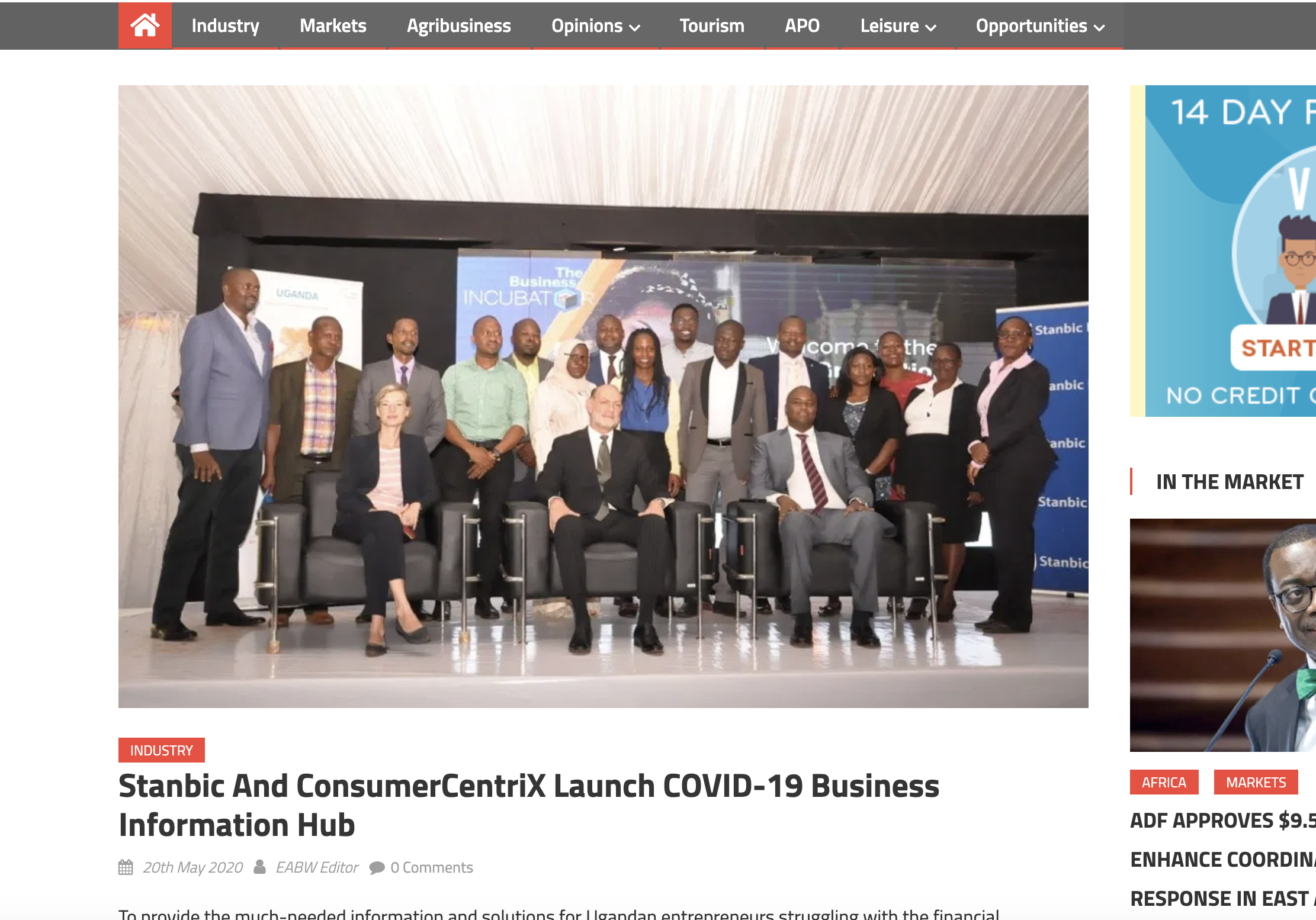
EABW NEWS | Stanbic And ConsumerCentriX Launch COVID-19 Business Information Hub
Stanbic And ConsumerCentriX Launch COVID-19 Business Information Hub
To provide the much-needed information and solutions for Ugandan entrepreneurs struggling with the financial consequences of the COVID -19 pandemic, Stanbic Bank has partnered with ConsumerCentriX on a Business Information Hub.
This website will provide entrepreneurs with advice on financial management to overcome economic slowdown and insights into new developments across industries.
Through a partnership with the African Management Institute (AMI), the Covid-19 Business Info Hub will promote informative virtual training sessions and webinars to help entrepreneurs navigate these challenging new circumstances.
Employing over 2.5 million people, small and medium enterprises (SMEs) are the key driver of growth for Uganda’s economy.


Rwandan Online Business Bootcamp Launched
Rwandan Online Business Bootcamp Launched
By Alejandra Ríos and Jessica Massie
A version of this article was originally posted on the SME Response Clinic
To support entrepreneurs in these challenging and unprecedented times, Access to Finance Rwanda (AFR) has partnered with the Rwanda Private Sector Federation and ConsumerCentriX on the SME Response Clinic. This digital platform provides entrepreneurs in Rwanda with information on financial management and industry insights to improve their response to this crisis.
However, information alone is not enough. As a result of this conviction, the SME Response Clinic is promoting a series of webinars and virtual programs through a partnership with the African Management Institute (AMI), to help entrepreneurs to adjust to financial uncertainty by deepening their skills and business acumen.
On Tuesday, May 12th, small businesses in Rwanda across sectors and with different business sizes joined the first FREE “Business Survival Bootcamp” facilitated by the African Management Institute (AMI).
Jean Bosco Iyacu of Access to Finance Rwanda (AFR), opened the webinar with a message of solidarity for the SME Response Clinic and SMEs in Rwanda.
The webinar takes businesses through important tools for planning during the COVID-19 pandemic.
These include:
- Scenario planning for your business – how do you deal with issues regarding customers, suppliers, infrastructure, staff and cash flow? How will these be affected if I close or have slow business for two weeks? What if it is two months?
- Organizational risk assessments – looking at the different dimensions of business, the risks they face, and how to mitigate them. What do you do if you can’t get the goods you need for your store, or supply your customers?
- Impact on cash flow – what to do if and when your cash flow is affected by an unexpected closure or low period.
All participants are given access to tools, such as cash flow planning spreadsheets, from AMI to use to help in their own businesses. These resources are free and designed specifically to navigate the issues in the COVID-19 pandemic, and include additional courses.

These tools and conversations are important given that the pandemic is likely to continue to affect SMEs in Rwanda – and around the world – for an unknown period of time. According to Diederik Wokke of AMI, many small businesses originally thought they would be affected for just the first two weeks of the lockdown. Now that the situation is stabilizing but slowly, businesses still need to build these skills and plan for a more uncertain future.
Conversation during the training highlighted some of the questions that SMEs have right now. For example, supplier negotiation is becoming more difficult now that businesses are able to open little by little. A shop renting a space may have had more flexibility in terms of payment during the lockdown, but this is changing as the country opens.
Finally, there are still many questions around payments and transferring to contactless mechanisms as much as possible. Many businesses are switching to digital payments and are still in the learning phase.
But with planning, management, and resources like those available from the SME Response Clinic, small businesses will be more likely to survive this pandemic.
Find out more about the upcoming sessions at “Expanding My Skills” on the SME Response Clinic website and on Facebook.
About the Authors
Alejandra Rios is an expert in inclusive finance with a focus on small-and-medium (SME) enterprises, advising leading commercial banks and microfinance institutions in emerging markets for the past twenty years. Her portfolio in MSME finance consultancy covers change management, housing finance, rural finance, institution-building, strategic planning, and credit management. She is a Partner at ConsumerCentriX.
Jessica Massie is a consultant in financial capability and microfinance based in Kigali, Rwanda. She has lived and worked in a variety of African countries for almost 20 years, and specializes in curriculum development, training, research and writing, with a focus on skill-building and behavior change. She is working with the ConsumerCentriX team on the SME Response Clinic in Rwanda.
RELEVANT NEWS & INSIGHTS


All Africa | Rwanda: COVID-19 - Private Sector Inks Deal to Support SMEs
All Africa | Rwanda: COVID-19 - Private Sector Inks Deal to Support SMEs
The Private Sector Federation on Monday, May 4, signed a Memorandum of Understanding with Access to Finance Rwanda in a new initiative aimed at supporting entrepreneurs in Rwanda to adjust to economic realities of COVID-19. The parties to the deal, as noted, seek to share their respective strengths, experiences, technologies, including technical assistance to facilitate Small and Medium Enterprises (SMEs) during the COVID-19 pandemic. They also seek to collectively support businesses in the short, medium, and long term.
Find more about SMEs support here.

Stanbic Uganda in partnership with ConsumerCentriX launch the COVID-19 Business Information Hub
“ConsumerCentriX is honored to continue working with Stanbic Bank on further strengthening its small and medium enterprise proposition to address these challenging times. Being relevant, providing support promptly can make the difference for enterprises today,”
-ANNA GINCHERMAN,PARTNER AT CONSUMERCENTRIX.
To provide the much-needed information and solutions for Ugandan entrepreneurs struggling with the financial consequences of the pandemic, Stanbic Bank has partnered with ConsumerCentriX on the Covid-19 Business Info Hub.
This website will provide entrepreneurs advice on financial management to overcome economic slowdown and insights into new developments across industries. Through a partnership with the African Management Institute (AMI), the Covid-19 Business Info Hub will promote informative virtual training sessions and webinars to help entrepreneurs navigate these challenging new circumstances.
Employing over 2.5 million people, small and medium enterprises (SMEs) are the key driver of growth for Uganda’s economy. However, as the COVID 19 pandemic unfolds, the SME sector faces reduced business activity and financial security as a result of disruptions to the supply chain, travel restrictions, and changing work environments.
Over the last few months, Stanbic Bank has already introduced a range of innovative products and services to support entrepreneurs with overcoming these challenges. For example, to address reduced revenues and cash flow, clients can now access an unsecured overdraft facility within 24 hours based on the performance of their banking history. To reduce disruptions in the supply chain, the bank has partnered with Zhejiang International Trading Supply Chain Co Ltd to support enterprise clients importing from China.
The Covid-19 Business Info Hub will become a centralized platform for Stanbic to communicate these responsive efforts with enterprise clients in Uganda. However, the vision of the site is to become a trusted resource for all entrepreneurs in Uganda, looking for industry insights and relevant virtual training sessions.
“We are aware of various the challenges businesses are facing especially during this time, and we are committed to unlocking new solutions to enable business continuity. Among the key initiatives, Stanbic has put in place to support businesses is the loan repayment holidays, as a measure to protect clients from adverse economic effects of the COVID-19 pandemic. We will also continue to be at the forefront of delivering wholesome solutions to entrepreneurs directly through strategic alliances and partnerships to keep them thriving during and post the pandemic,” said Grace Muliisa, Stanbic Uganda’s Head of Personal and Business Banking
As the implementing partner, ConsumerCentriX is well-positioned to support Stanbic Bank’s on this critical endeavor. ConsumerCentriX is an international strategy consulting firm that works with financial service providers and policymakers on translating consumer insights into market strategies and policies to reach the un/undeserved. The firm has extensive experience supporting SME development in East Africa through financial and non-financial services.
“ConsumerCentriX is honored to continue working with Stanbic Bank on further strengthening its small and medium enterprise proposition to address these challenging times. Being relevant, providing support promptly can make the difference for enterprises today,” said Anna Gincherman, Partner at ConsumerCentriX.
Visit the Covid-19 Business Info Hub