


How is PSFU engaging its members and government to support businesses through the COVID-19 crisis?
How is PSFU engaging its members and government to support businesses through the COVID-19 crisis?
To provide the much-needed information and solutions for Ugandan entrepreneurs struggling with the financial consequences of the pandemic, Stanbic Bank has partnered with ConsumerCentriX on the Covid-19 Business Info Hub. This interview originally appeared under “insights for my business” section of the hub.
The COVID-19 Business Info Hub spoke with Francis Kisirinya, Deputy Executive Director of Private Sector Foundation Uganda (PSFU), about the ways in which PSFU is engaging its members and government to support businesses through the COVID-19 crisis.
Our role as PSFU to support businesses is three-fold: first, representation and engagement with government; second, building and supporting businesses to be able to do their business better; and third, mobilizing resources to address the challenges they face.
What advocacy efforts is PSFU undertaking to support SMEs during this time?
PSFU has been and continues to be actively engaged in discussions with the government on issues critical to businesses in the private sector including ensuring timely payments by the government to suppliers, supporting the financial sector in relaxing loan repayment requirements for some borrowers, supporting businesses in maintaining liquidity and accessing affordable finance, and highlighting the importance of business development services. Proposals PSFU has made are already being adopted [by government], and [PSFU] is optimistic that additional suggestions will soon be implemented.
How does PSFU support businesses directly?
It is very clear that business owners need to enhance digital skills. From a policy perspective, PSFU is proposing things that can be done to improve infrastructure and internet availability across the country. On the side of business owners, PSFU offers support with publicity as well as skills building for employees as they work. MSMEs trading today need to include a digital delivery channel. Companies interested in participating in training are encouraged to respond to PSFU’s calls for proposals.
How can businesses engage with PSFU?
PSFU Services is found on Plot 43 Nakasero Road Kampala
Call us on: +256312263850
Email: klmusoke@psfuganda.org.ug
Twitter: @psfug
Facebook: Private Sector Foundation Uganda (PSFU)
Skills Development Facility email contact: dmugoya@psfuganda.org.ug
Q: Introduction
My name is Francis Kisirinya. I am the Deputy Executive Director of Private Sector Foundation Uganda. My day job is to ensure that I am able to link the private sector to policymakers and able to help them improve any issues they have via our programs. We support their capacity building and mobilize resources to support the private sector in Uganda. PSFU has 250 members, which are groups that come from and cover sectors like manufacturing, education, hospitality, insurance, banking, agriculture, mining, trade, commerce – every part of the economy is represented. Those are the direct members. Indirectly, if you look are those organizations and the members under them, we have almost 50,000 businesses indirectly represented and engaged by us.
Q: What is PSFU’s role in support to the private sector and SMEs in particular?
Our role as PSFU is three-fold: first, representation. We represent MSMEs [Micro Small and Medium Enterprises] in places where they are not located. For instance, not all of our traders in markets and shopping malls will be sitting down with government to discuss policy. We have a mechanism through which we reach the members, through the organizations that they are members of. We represent them in government, in terms of policy making. We conduct research and look at policy options and engage with government to discuss policies that will aid their businesses. The second mandate is to build and support businesses to be able to do their business better. You need skills, capital, technology, and so on and so forth. It is our role to be aware of these things and ensure that you benefit from them, that you build your capacity to be able to compete. We also are required to mobilize resources to address your issues. For instance, the country has substantial competitiveness challenges, both at the national level and among our businesses. We look out for resources to help businesses deal with issues affecting their competitiveness. If you look at manufacturing, for instance, they face issues in terms of technology. As PSFU, we can intervene in this area to identify funders, providers of those types of technology so businesses can identify and implement this technology to be able to compete with everyone doing business in the country.
Q: What considerations does PSFU have for smaller member groups such as SACCOs?
For smaller member groups such as SACCOs, we have a two or three track arrangement. First, they must be our members. As members, they are able to discuss and bring their issues [forward]. We bring you together so that you are able to network and work with others. The second thing is that we work with small enterprises in increasing their ability to do their businesses better. One of the things that is a big challenge for SACCOs is in terms of access and utilization of technology. Today’s consumer wants to trade on their phone, banking on their phone, access loans on their phone. Many SACCOs do not have this particular capacity to access this technology. PSFU is actively engaging with providers to make sure SACCOs can access things like this. We are also actively engaging with the government to make sure that SACCOs are able to have some resources that are affordable to on-lend to members of the SACCOs.
Q: What has the impact of COVID-19 been on the SME sector?
PSFU has grouped the impact into three areas; the first one is the markets. Because of the various decisions and new standard operating procedures that have been instituted (such as social distancing), businesses’ access to markets have been curtailed. People are not able to go shop. Those who shop and those who do the trading themselves have not been able to go [to markets]. This is also true for those exporting goods. Those exporting goods are also affected. It is also true for those obtaining supplies, whether locally or through the international community. They are not able to access these particular markets. This has a lot of implications down the roads because activity has been reduced while fixed costs have not been reduced. You pay rent whether you are working or not. The second area of impact which we have seen is the drying up of cash. Companies do not have cash anymore. Very few people are coming [to do business]. Your employees need the cash, financiers who have provided you financing need the cash, you also need the cash. There is very little cash. This is causing a lot of challenges for a number of MSMEs. The next area is in terms of being forced to work in different ways. We are seeing a change in the kind of demands that consumers are putting on MSMEs. Consumers are requiring that MSMEs put in [place] safety measures. As an MSME, you have to invest in safety, address this and invest in personal protective equipment. This is affecting these businesses seriously. Many businesses are facing substantial losses at this time.
Q: Do you have any indicative numbers on where the greatest impact has been?
For the tourism sector for instance, the impact has been 100%. The sector is totally closed down. There are probably 30,000 employees that are home. In the export sector, they are also reducing staff significantly. In manufacturing, they are doing some minimal work, but it is impossible for them to do what they were doing before. Many are reducing staff counts by about 30% in the manufacturing sector alone. In trade, many are not working. These are all jobs that have been lost.
Q: What plans for advocacy does PSFU have in mind to support SMEs?
From the perspective of advocacy to ensure MSMEs are supported, we have been engaging with the government over the last few months and highlighted to them a number of things that they can do. The first is in dealing with issues of liquidity. We have proposed that the government should pay all people who have supplied it goods quickly. There is an issue in the government of sometimes purchasing goods but not paying quickly. We have asked that they make these payments. We supported MSMEs and requested that they submit to us all of their claims. By April 20, we submitted a list with over 1 trillion shillings in terms of unpaid bills, and the government agreed to make these payments. I will also recommend that the businesses, the MSMEs, pay their suppliers if they have some cash. Pay your supplier, pay your employees. That also helps. The second thing that we’ve asked the government to help with is to see that companies’ tax refunds are released. The Uganda Revenue Authority has provided guidance on how to make these refunds much quicker, so they have responded. We have also requested that the financial sector relax the loan repayment requirements with some of their borrowers. The Bank of Uganda has given very good guidance on this in terms of suspending payments, moratoriums on payment of interest, restructuring loans. All those have actually been done, and the government and Bank of Uganda have advised the government that for some requirements that were previously needed before a loan could be restructured, they be waived – even if a loan is in arrears, present yourself to the bank, and the bank will be able to advise you and you can then move forward. The third area we have done on advocacy is to advise the government not to consider increasing taxes. We also wanted some to be reduced so that businesses have some more liquidity to work with. We have advised incentives that were done a few years ago, such as investment incentives, be reinstated so that some companies with extra cash can invest. The fourth area where we have asked government for support is in terms of building alternative markets and access to those markets. We know that today markets in Europe, Asia, and the Middle East are facing challenges because of this virus. We need to find alternative markets, or if not alternative markets, new consumers in these markets. We ask that they make sure consumers still have Uganda in their minds so that when the whole world opens again, they come back for tourism and they continue to buy goods from Uganda. We have also asked that government focus strongly on enterprise development. We need to ensure that we create and build enterprises that are sustainable. The biggest piece of that is providing financing that is affordable but also long term. We insisted that the Ugandan Development Bank be recapitalized so that it is ready to lend out to the MSMEs, to the private sector. When there is affordable finance, we will see investments into MSMEs and MSMEs being more resilient than they are today. We also know that business development services are so critical, so crucial. MSMEs sometimes fail to pay their loans purely because of the additional things that they should have done but do not do. This includes financial literacy and proper preparation of a loan proposal. Business development services is a very important thing that we have asked government to pay attention to so that when businesses come back and access financing, they are able to be resilient and are not affected by things like this virus. We have also requested that the government look at insolvency law, not only in terms of how to organize it and prepare a company that has failed, but it should now have a component of reinvestment. Meaning if a company is insolvent its commitments, don’t just move to sell it. Allow and rehabilitate it. You might need to reinvest in it – reinvest in it and bring it back. In many countries, this facility exists, and they are saving their companies. This is how you have companies that have been in existence for hundreds of years. As we engage government and tell us what they should help us with, we also have our own responsibilities, our own tasks to do. We have learned that we have to have savings. We have to look very closely at what we are spending. We must reduce and optimize costs so that we save for a rainy day. Try to learn how to work with insurance services, understand social safety nets. How can we engage with them? Are they being run properly? If you have an insurance policy, savings, a network of support systems, you are more likely to come back. The other thing that we have talked about very strongly is that government should look at alternative ways of accessing markets. For instance, there are markets for exports in Europe and North America for which we do not have cargo transport capability. We also have to look at how to trade in other markets for Uganda where there are concerns about not being paid. The government needs to support us in trading in some of these markets. We need things like insurance coverage for this. We have connected very well with the government and are quite happy that we are all aiming towards improving and saving our economy.
Q: Will these proposals be adopted by government?
As you can see, a number of these proposals are already being adopted. On the banking side, you can see things being done. The other day the President wrote about securing money to support production. You have seen URA helping the administrative procedures for tax refunds. In the [national] budget, no taxes are going to be increased. There were proposals for increasing taxes this year that are now not there. We will get some room to build ourselves back. The other proposals that we have made are under discussion, and the discussion is going very well. We are very optimistic that the suggestions that we have made are going to be implemented.
Q: What solutions does PSFU have towards training entrepreneurs on digital trading and working remotely?
It is very clear that we need to enhance digital skills everywhere. As PSFU, what we are doing to enhance digital skills is to propose from the policy perspective what things should be done so that internet and digitization is available in the country. We are happy that infrastructure has been put in place and many companies are working to provide this service. There is a component that is a bit of an issue at the moment – that the quality needs to be improved by the service provider. We are encouraging as much as possible those MSMEs that are operating in the digital space to innovate, have new products that companies can use to reach markets. You need to be able to supply your consumers using different approaches, digital being one of them. We are supporting MSMEs involved in e-commerce applications. We are helping them with publicity, with policy support, and have products at PSFU to improve capabilities of employees as they work. If you are an MSME trading today, you need to include a digital delivery channel in your supply chain. If you do not add digital, you will have a greater challenge for yourself. Have digital approaches to reaching your customers.
Q: How can someone access PSFU training?
Today, we ask companies that would like to participate in our skills program, we publish a call for proposals. When a proposal comes out, someone applies to receive grants so that they can be in a position to upskill your staff. We are talking to development partners to increase the tools we have to support MSMEs. Look out for our call for proposals and please participate.
Q: What is PSFU doing in regard to the issue of tenancy for entrepreneurs in huge malls in Kampala and rent?
If tenants are not working, it is unlikely that they will find money to pay landlords. But landlords have also raised the issue that these malls and buildings are being funded by financial institutions. The financial institutions have provided relief but still need to be paid these installments. We are working to try and find a way through which tenants and landlords can find a way to come to an agreement. We have also asked the government to wave some taxes during this time. We are encouraging the engagement between ourselves, the tenants, landlords, and the government so that we have an amicable solution for the issue of rent due during COVID-19. We also encourage landlords to support and help your tenants to rebuild their businesses. Let’s find a brotherly approach, ensuring we support each other. Tenants, please also do your part, keep your word. Do what it takes to deliver on your word.

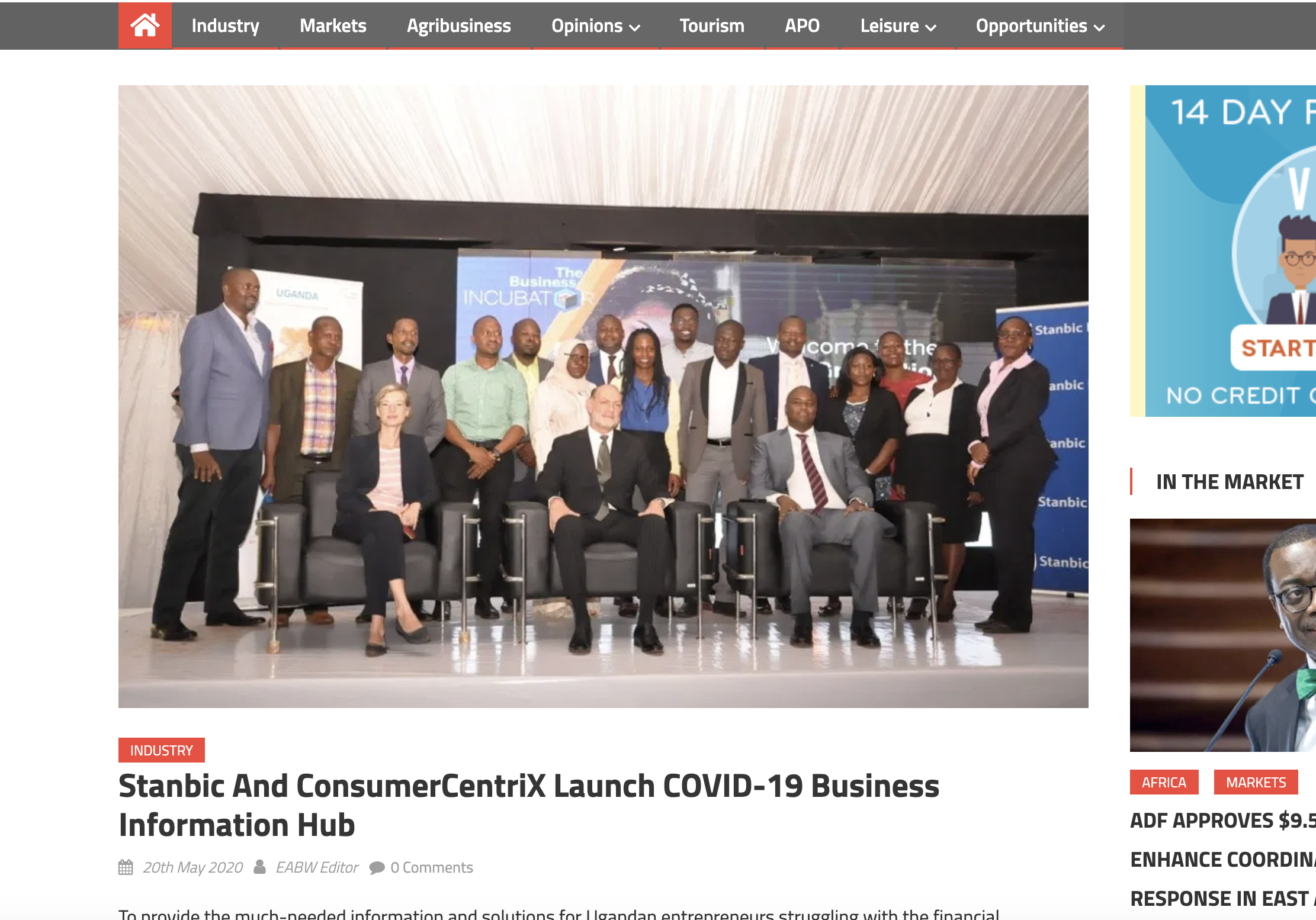
EABW NEWS | Stanbic And ConsumerCentriX Launch COVID-19 Business Information Hub
Stanbic And ConsumerCentriX Launch COVID-19 Business Information Hub
To provide the much-needed information and solutions for Ugandan entrepreneurs struggling with the financial consequences of the COVID -19 pandemic, Stanbic Bank has partnered with ConsumerCentriX on a Business Information Hub.
This website will provide entrepreneurs with advice on financial management to overcome economic slowdown and insights into new developments across industries.
Through a partnership with the African Management Institute (AMI), the Covid-19 Business Info Hub will promote informative virtual training sessions and webinars to help entrepreneurs navigate these challenging new circumstances.
Employing over 2.5 million people, small and medium enterprises (SMEs) are the key driver of growth for Uganda’s economy.


All Africa | Rwanda: COVID-19 - Private Sector Inks Deal to Support SMEs
All Africa | Rwanda: COVID-19 - Private Sector Inks Deal to Support SMEs
The Private Sector Federation on Monday, May 4, signed a Memorandum of Understanding with Access to Finance Rwanda in a new initiative aimed at supporting entrepreneurs in Rwanda to adjust to economic realities of COVID-19. The parties to the deal, as noted, seek to share their respective strengths, experiences, technologies, including technical assistance to facilitate Small and Medium Enterprises (SMEs) during the COVID-19 pandemic. They also seek to collectively support businesses in the short, medium, and long term.
Find more about SMEs support here.

Stanbic Uganda in partnership with ConsumerCentriX launch the COVID-19 Business Information Hub
“ConsumerCentriX is honored to continue working with Stanbic Bank on further strengthening its small and medium enterprise proposition to address these challenging times. Being relevant, providing support promptly can make the difference for enterprises today,”
-ANNA GINCHERMAN,PARTNER AT CONSUMERCENTRIX.
To provide the much-needed information and solutions for Ugandan entrepreneurs struggling with the financial consequences of the pandemic, Stanbic Bank has partnered with ConsumerCentriX on the Covid-19 Business Info Hub.
This website will provide entrepreneurs advice on financial management to overcome economic slowdown and insights into new developments across industries. Through a partnership with the African Management Institute (AMI), the Covid-19 Business Info Hub will promote informative virtual training sessions and webinars to help entrepreneurs navigate these challenging new circumstances.
Employing over 2.5 million people, small and medium enterprises (SMEs) are the key driver of growth for Uganda’s economy. However, as the COVID 19 pandemic unfolds, the SME sector faces reduced business activity and financial security as a result of disruptions to the supply chain, travel restrictions, and changing work environments.
Over the last few months, Stanbic Bank has already introduced a range of innovative products and services to support entrepreneurs with overcoming these challenges. For example, to address reduced revenues and cash flow, clients can now access an unsecured overdraft facility within 24 hours based on the performance of their banking history. To reduce disruptions in the supply chain, the bank has partnered with Zhejiang International Trading Supply Chain Co Ltd to support enterprise clients importing from China.
The Covid-19 Business Info Hub will become a centralized platform for Stanbic to communicate these responsive efforts with enterprise clients in Uganda. However, the vision of the site is to become a trusted resource for all entrepreneurs in Uganda, looking for industry insights and relevant virtual training sessions.
“We are aware of various the challenges businesses are facing especially during this time, and we are committed to unlocking new solutions to enable business continuity. Among the key initiatives, Stanbic has put in place to support businesses is the loan repayment holidays, as a measure to protect clients from adverse economic effects of the COVID-19 pandemic. We will also continue to be at the forefront of delivering wholesome solutions to entrepreneurs directly through strategic alliances and partnerships to keep them thriving during and post the pandemic,” said Grace Muliisa, Stanbic Uganda’s Head of Personal and Business Banking
As the implementing partner, ConsumerCentriX is well-positioned to support Stanbic Bank’s on this critical endeavor. ConsumerCentriX is an international strategy consulting firm that works with financial service providers and policymakers on translating consumer insights into market strategies and policies to reach the un/undeserved. The firm has extensive experience supporting SME development in East Africa through financial and non-financial services.
“ConsumerCentriX is honored to continue working with Stanbic Bank on further strengthening its small and medium enterprise proposition to address these challenging times. Being relevant, providing support promptly can make the difference for enterprises today,” said Anna Gincherman, Partner at ConsumerCentriX.
Visit the Covid-19 Business Info Hub
RELEVANT NEWS & INSIGHTS


Introducing the SME Response Clinic
The Private Sector Federation, Access to Finance Rwanda and ConsumerCentriX in a Joint Covid-19 Response Partnership for Support to Rwanda’s Medium, Small and Micro Enterprises.
READ THE OFFICAL STATEMENT TO THE PRESS
Kigali – 5th May 2020: To support entrepreneurs in Rwanda struggling to adjust to the economic realities of Covid-19, the Rwanda Private Sector Federation has partnered with Access to Finance Rwanda (AFR) and ConsumerCentriX on the SME Response Clinic. This digital platform will translate new policies and financial advice using a clear and straightforward language in both English and Kinyarwanda.
With 148,092 MSMEs in Rwanda representing 99.7 percent of the businesses according to the Integrated Business Enterprise Survey (2017) by the National Institute of Statistics of Rwanda (NISR), this sector plays a pivotal role in the country’s socio-economic development.
However, getting access to the right information, training, and finance is no easy feat. Even before the crisis, a number of studies, including ConsumerCentriX’s research in May 2019 and Private Sector Federation’s Business and Climate Survey April 2019 respectively indicate MSME owners face several critical challenges even at the time of economic growth and stability.
The consequences of COVID-19 pandemic further exacerbate challenges faced by MSMEs by significantly reducing their business activities and financial security. The Rwandan government and financial sector have taken several significant measures to support MSMEs during this challenging period. To ensure that these important measures are communicated to MSMEs in an accessible and timely manner, the Private Sector Federation in partnership with Access to Finance Rwanda and ConsumerCentriX developed the SME Response Clinic, a digital platform that translates relevant policies and financial advice to the SMEs.
For high quality and relevant content, interviews will be regularly conducted with financial service providers, industry experts, policymakers, and MSMEs. All information will be centralized on the SME Response Clinic website and promoted through SMS, social media campaigns, and different media channels.
“Being the catalyst of a deeper and inclusive financial sector in Rwanda, Access to Finance Rwanda sees the MSME Response Clinic as a key tool in addressing information asymmetry between policymakers, Financial Services Providers and the MSMEs. It also provides an opportunity to understand the real needs of SMEs so as to be able to effectively support them during this unprecedented crisis of Covid-19” said Waringa Kibe, AFR Country Director.
Ms. Anna Gincherman, Partner of ConsumerCentriX believes that if well implemented, the new partnership will yield positive results for the Country’s private sector. “As the leading implementing agency for this project, ConsumerCentriX is well-positioned to accomplish the project objectives due to its extensive background in SME development in Sub-Saharan Africa, including Rwanda, its expertise in working with financial service providers and regulators, and its in-house capacity to manage digital communication,” she added.
Meanwhile, The Private Sector Federation Chief Executive officer Mr. Stephen Ruzibiza commended the new partnership adding that it has come at the right time when MSMEs need strong recovery approaches in terms of various aspects including to the right information and access to finance.
“We welcome this partnership as the SME Response Clinic will provide and collect needed information that will enable key stakeholders to support the resilience of the MSME Sector in this period of Covid-19, ” said Mr. Ruzibiza.
Through a partnership with the African Management Institute (AMI), the SME Response Clinic will be promoting a series of webinars and virtual programs to help entrepreneurs adjust to new realities and ensure resiliency for the future.
For more information, please contact.
Musa Kacheche
Communication & Media Lead
ConsumerCentriX
Email: musa.kacheche@consumercentrix.ch