


ConsumerCentriX Participates in and Co-organizes Two-Day Workshop on WE Finance Code in Georgia
ConsumerCentriX (CCX) had the privilege of co-organizing a two-day workshop in partnership with the European Bank for Reconstruction and Development (EBRD) and the National Bank of Georgia (NBG). The workshop focused on advancing financial inclusion for women-led enterprises in Georgia, an important step towards improving access to finance for Women-Owned Small and Medium Enterprises (WSMEs).
Day 1: Leveraging Data for Advancing Finance to Women Entrepreneurs
The first day began with a comprehensive analysis of Georgia’s WSME Finance Landscape. High-level representatives from the private sector and key ecosystem stakeholders attended the session, which opened with welcoming remarks by Ms. Natia Turnava, Acting Governor of NBG, and Mr. Alkis Vryenios Drakinos, Regional Head of Caucasus at EBRD.
Anna Gincherman from CCX set the stage by providing an insightful overview of international developments in gender-disaggregated data. She highlighted the business case for collecting and analyzing this data, revealing that while women-owned enterprises constitute around 32% of all SMEs in Georgia, they account for only 7.5% of formal credit access. This gap underscores the importance of developing targeted financial solutions for women entrepreneurs.
David Taylor of CCX followed by introducing the WSME Dashboard (https://www.wefinancegeorgia.ge/), an analytical and data visualization tool designed to provide insights into the financial landscape for WSMEs. The Dashboard sparked lively discussions among participants, who explored its potential applications for their own institutions.
Later in the day, Ms. Aurica Balmus, Principal of Gender and Economic Inclusion at EBRD, gave an in-depth presentation on the WE Finance Code and its potential impact on Georgia’s financial sector, particularly in improving access to finance for women-led businesses.
The session concluded with a presentation by Mr. David Utiashvili, Head of the Financial Stability Department at NBG. Mr. Utiashvili shared the regulator’s vision for the future of the WSME Dashboard, calling for collaboration between financial service providers (FSPs) and other stakeholders to enhance its capabilities. His remarks emphasized the need for collective efforts to ensure that the Dashboard becomes a valuable tool for increasing financial inclusion for WSMEs in Georgia.
Day 2: WE Finance Code – Data-Driven Strategies for Financing Women-Led Enterprises
The second day took a more interactive approach, with participants from financial institutions, including data, product, and ESG managers, as well as representatives from the Georgian Bankers Association. The discussion centered on their experiences working with the WSME segment and sex-disaggregated data.
Istvan Szepesy and Anna Gincherman from CCX led the morning session, focusing on strategies for capturing and managing gender data. They encouraged participants to critically assess their current data collection and analysis methods and offered practical recommendations for improvement.
David Taylor returned to share emerging insights from the WSME Dashboard, illustrating how the tool can inform data-driven decisions for financial service providers. Participants actively engaged in discussions on how the Dashboard can be further integrated into their day-to-day operations.
The workshop concluded with a presentation by Ms. Dana Kupova, Head of Inclusive Finance at EBRD, who outlined how EBRD could support banks in Georgia as they work to better serve women-led enterprises. Her remarks highlighted the growing opportunities for financial institutions to create tailored products and services that address the unique needs of WSMEs.
Looking Ahead
The two-day workshop demonstrated the power of collaboration between public and private sector stakeholders in advancing financial inclusion for women-led businesses. It also underscored the importance of data-driven strategies in fostering sustainable growth and access to finance for WSMEs.
We extend our heartfelt thanks to all participants for their active involvement and to the National Bank of Georgia, especially Salome Tvalodze and David Utiashvili, for their ongoing support and collaboration in developing the WSME Dashboard and organizing this impactful event.
As part of the ongoing implementation of the WE Finance Code in Georgia, CCX, EBRD, and NBG remain committed to working together to enhance financial access for women-led MSMEs and support their continued growth and success.
Press Release: Workshop on WE Finance Code


ConsumerCentriX attends the 2024 Financial Alliance for Women Annual Summit
ConsumerCentriX attends the 2024 Financial Alliance for Women Annual Summit.
The ConsumerCentriX (CCX) team had an exciting two days at the 2024 Financial Alliance for Women Annual Summit, participating in sessions and engaging in conversations with a diverse group of industry leaders. The Summit focused on advancing women through the entrepreneurial funnel, a critical issue in today’s economic landscape.
One of the key themes of the Summit was the vital role of sex-disaggregated data in driving actionable insights. Our senior advisor, David Taylor, had the opportunity to present our work on the Women’s Financial Inclusion Dashboards in Bangladesh and Nigeria. During the National Gender Data Dashboards panel, David highlighted the significance of data for regulators, stating, “Regulators need to recognise the power that data can present. The insights you present back to the market can be as powerful as the policies you set.”
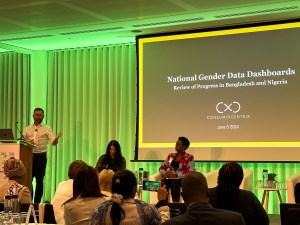
Following the Summit, the WFID Partnership Community of Champions held its third in-person convening. The WFID Partnership Community of Champions, a collaborative initiative facilitated by the Financial Alliance for Women (FAW) and ConsumerCentriX, brings together financial policy stakeholders from around the world. For the past three years, this community has been instrumental in sharing experiences and best practices aimed at increasing the collection and use of supply-side data to promote women’s financial inclusion (WFI). The recent convening showcased the latest innovations in applying gender data to inform policy-making and drive actions towards closing the financial inclusion gender gap.


David Taylor facilitated a session on National Gender Data Dashboards featuring distinguished speakers such as Sophia Abu from the Central Bank of Nigeria, Shahana Ferdousi from Bangladesh Bank, and Paula Ximena Franco from Superintendencia Financiera de Colombia. They discussed key learnings from our work on developing Women’s Financial Inclusion Data Dashboards in Bangladesh and Nigeria. Anna Gincherman, a partner at CCX, moderated a dynamic discussion among policymakers from Colombia, Peru, Honduras, Chile, Nigeria, Pakistan, and Bangladesh. The conversation focused on how to best apply supply-side data to shape women’s financial inclusion priorities, highlighting the collaborative efforts needed to drive meaningful change.
About the Summit
The Financial Alliance for Women’s Annual Summit is the premier event focused on the power of the female economy. Each year, the Alliance convenes financial, technology and real sector players to share business solutions for women’s financial empowerment.

ConsumerCentriX and Bangladesh Bank Launch the Women's Financial Inclusion Data Dashboard
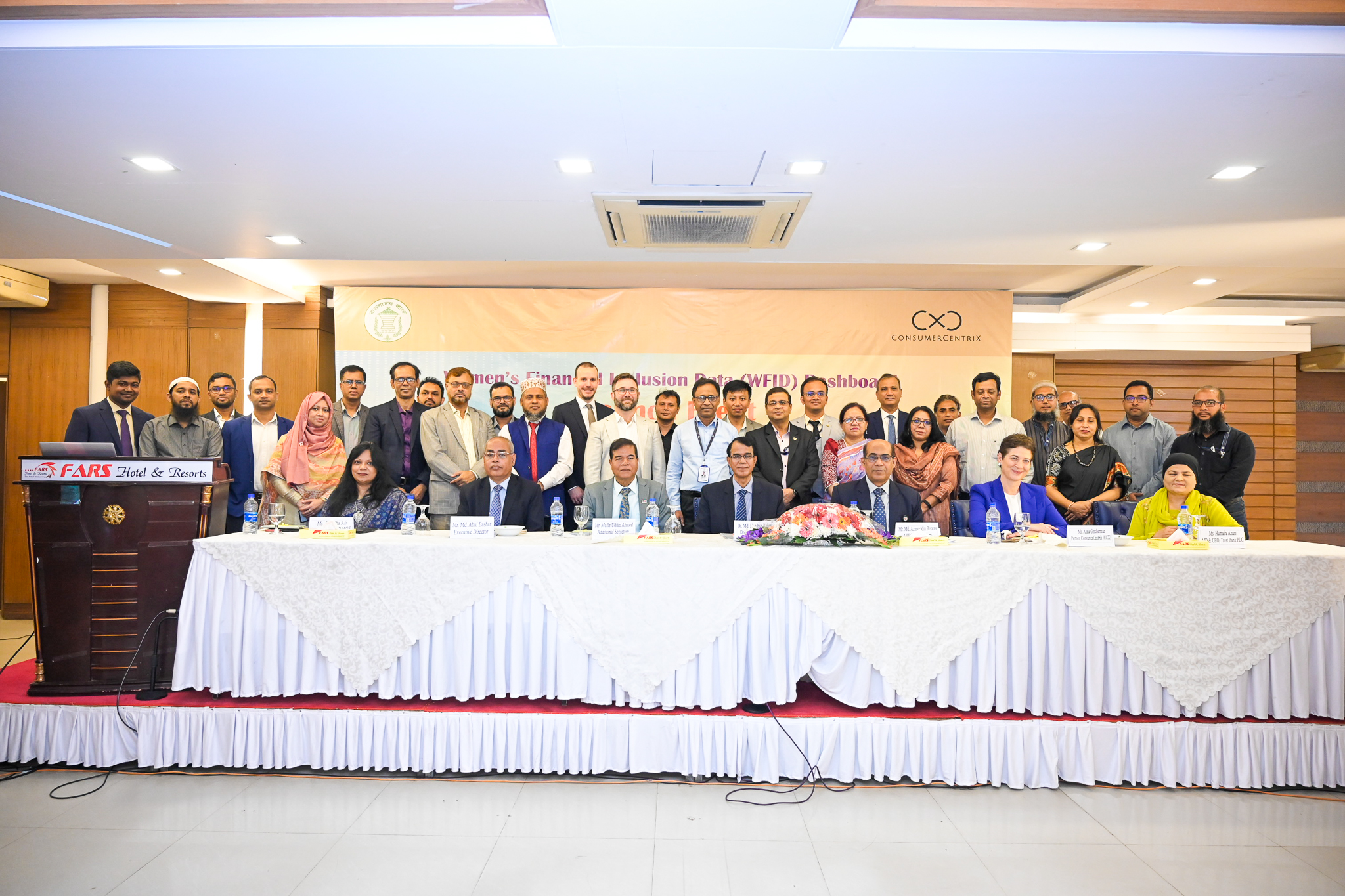
ConsumerCentriX and Bangladesh Bank co-hosted the launch event of the Women’s Financial Inclusion Data Dashboard, which had been developed in collaboration with the Financial Alliance for Women.
The event was inaugurated by Mr. Md. Abul Bashar, Executive Director of Bangladesh Bank, and saw the participation of over 100 stakeholders from Bangladesh’s financial services sector, including financial service providers, regulators, and development finance institutions.
In a keynote address, the Deputy Governor of Bangladesh Bank, Md. Habibur Rahman, PhD highlighted the importance of the the WFID dashboard’s vital role in facilitating informed policy-making and driving large-scale, impactful financial industry initiatives to enhance women’s financial inclusion in Bangladesh. Following the keynote, Mr Mofiz Uddin Ahmed, Additional Secretary from the Finance Division, Ministry of Finance, stressed the critical contribution of the microfinance sector to reaching women, especially in rural areas.
Shahana Ferdousi of the National Financial Inclusion Strategy Administrative Unit at Bangladesh Bank, István Szepesy, and David Taylor of ConsumerCentriX presented the content and key features of the dashboard.
The WFI Data Dashboard is designed to represent the landscape of women’s financial inclusion in Bangladesh utilizing data collected by BangladeshBank, which has been publicly available but fragmented in multiple independent data sources and files. The dashboard now collects and combines all relevant information in one place with easy-to-navigate functionality.
The formal launch was followed by a panel discussion titled “Sex-disaggregated Data to Promote Women’s Financial Inclusion in Bangladesh,” moderated by Anna Gincherman, partner at CCX. Snigdha Ali from the Bill & Melinda Gates Foundation, Azimuddin Biswas, Additional Secretary from the Finance Division, Ministry of Finance, Government of Bangladesh, and Humaira Azam, CEO of Trust Bank Limited, discussed how financial service providers and policymakers are using data to drive women’s financial inclusion efforts in Bangladesh.
We extend our deepest gratitude to Bangladesh Bank, our co-host, and all the participants who contributed to making the event a resounding success.


Anna Gincherman to Speak at 2021 Financial Alliance for Women Annual Summit

Anna Gincherman to Speak at 2021 Financial Alliance for Women Annual Summit
Anna Gincherman, a Partner at ConsumerCentriX, will speak at the Financial Alliance for Women’s Annual Summit for the third consecutive year. The Summit is known as the world’s most seminal and comprehensive event for women’s financial inclusion, with participation from bankers, policymakers, multilateral and bilateral officials, academics, and other stakeholders.
The 2021 Summit, titled “Investing in Women, Transforming Our World,” will address a wide range of topics, including introducing national measures to promote female-friendly entrepreneurial ecosystems, designing gender-aware fintechs, and developing tomorrow’s JEDI (justice, equality, diversity, and inclusion) workforce.
This year the event will take place virtually between October 5 and 7.
More information about the event can be found here.


Kwinjiza Ibigo by’ubucuruzi bito n’ibiciriritse byo mu Rwanda mu bucuruzi bukoresha ikoranabuhanga: Amahirwe n’inzitizi zirimo.
Kwinjiza Ibigo by’ubucuruzi bito n’ibiciriritse byo mu Rwanda mu bucuruzi bukoresha ikoranabuhanga: Amahirwe n’inzitizi zirimo.
Kuwa 30 Werurwe 2021 saa cyenda z’amanywa
Utumiwe mu kiganiro nyunguranabitekerezo kizakoreshwa na SME Response Clinic hifashishijwe ikoranabuhangakikazakorwa hamwe n’abafatanyabikorwa b’ingenzi bakomoka mu nzego za Leta n’iz’abikorera zifite uruhare mu bucuruzi bukoresha ikoranabuhanga mu Rwanda. Icyo kiganiro kizakorwa hakoreshejwe ikoranabuhanga kizabakigamije kungurana ibitekerezo ku bikorwa biriho byo kwinjiza ibigo by’ubucuruzi bito n’ibiciriritse mu mahuriroy’ibigo bikora ubucuruzi bikoresheje ikoranabuhanga kikazibanda ku mahirwe ibigo bito n’ibiciriritse bifite muri urworwego , inzitizi bihura nabyo, ndetse n’ibisubizo bishoboka bijyanye no gukuraho izo nzitizi.
Icyo kiganiro kizanyura kuri paji ya Facebook ya SME Response Clinic; abazakitabira bakazabasha kubaza ibibazo no gutanga ibitekerezo byabo kuwa 30 Werurwe saa cyenda z’amanywa mu rurimi rw’ikinyarwanda ahanini.
Uzayobora ikiganiro: Christophe Nkurunziza: Umuyobozi wa IHUZO PROJECT
Abatumirwa:
- Alex Ntale: Umuyobozi Mukuru wa ICT Chamber
- Albert Munyabugingo: Umuyobozi Mukuru wa Vuba Vuba
ConsumerCentriX is a Proud Co-Sponsor of this Event

MFW4A webinar: Gender finance as an opportunity during crisis times

MFW4A webinar: Gender finance as an opportunity during crisis times
Alejandra Rios, Partner at ConsumerCentrix, recently participated in a webinar hosted by Making Finance Work for Africa Partnership (MFW4A).This article originally appeared on Platform Africa’s website.
By Erica Yanice B.Essono Nze-Bekale, Darylle Tangara & Karungi Kajura
Women entrepreneurs represent a real opportunity for financial institutions provided they develop products and services as well as a suitable environment to meet their specific needs
Statistics have shown that female entrepreneurship in Africa is the highest in the world at 24 percent compared to 11 percent South East Asia Pacific and 9 percent Europe. It was also noticed that as borrowers, women entrepreneurs repay better than men. However, they face multiple constraints specific to them (household management, interruption of working life due to maternity and illnesses of their children). In addition, they are more vulnerable in times of crisis, but are better able to proactively seek solutions with Financial Institutions in times of crisis.
Addressing this issue, on 4 March 2021, the Making finance Work for Africa Partnership (MFW4A) in collaboration with the IPC, Horus and IECD Consortium hosted a webinar entitled “Gender finance as an opportunity during crisis times”. This session was the last of a series of four (4) webinars dedicated to banks and microfinance institutions in West and Central Africa within the context of the European Investment Bank (EIB) TA Financial sector programme for these regions.
Platform Africa covered the fourth session, and it dealt with topics relating to the financing of entrepreneurship and finance for women as an opportunity in such a crisis. The goal was to help realise the full potential of the African financial sector and stimulate economic development and reduce poverty.
The session was moderated by Edwige Takassi, from IPC GmBH and member of the Women in Africa Network and the three panellists sharing their insights on this topic were: Kady Traoré, Managing Director of Fin’elle of Group Cofina; Alejandra Rios, Partner at ConsumerCentrix and Head of the African Women Rising Initiative (AWRI) funded by the EIB, and Tania Colantone, Social Development Specialist at EIB.


Enhancing your Business Management Skills as Rwanda Reopens for Business
Enhancing your Business Management Skills as Rwanda Reopens for Business
February 18th, 2021, at 3 pm CAT
Join the SME Response Clinic for a live discussion featuring business development services providers in Rwanda. Learn about opportunities to enhance your management skills as Rwanda reopens for business. The discussion will be hosted on the SME Response Clinic’s Facebook page on February 18th at 3 pm CAT and held primarily in Kinyarwanda.
Moderator: Eric Musizana, Agriculture & Rural Finance Project Officer, Access to Finance Rwanda
Panelists:
- Dr. Mukulira Olivier, Managing Director at the Rwanda Institute of Cooperatives, Entrepreneurship, and Microfinance
- Sarah Mukunde, Senior Manager, Westerwelle Startup Haus Kigali
- Malik Shaffy Lizinde, Country Manager, African Management Institute
Please note that the Livestream will not be available until 3 pm CAT on February 18th, 2021

Relief Measures Available for Women Entrepreneurs During and Post Covid-19
Relief Measures Available for Women Entrepreneurs During and Post Covid-19
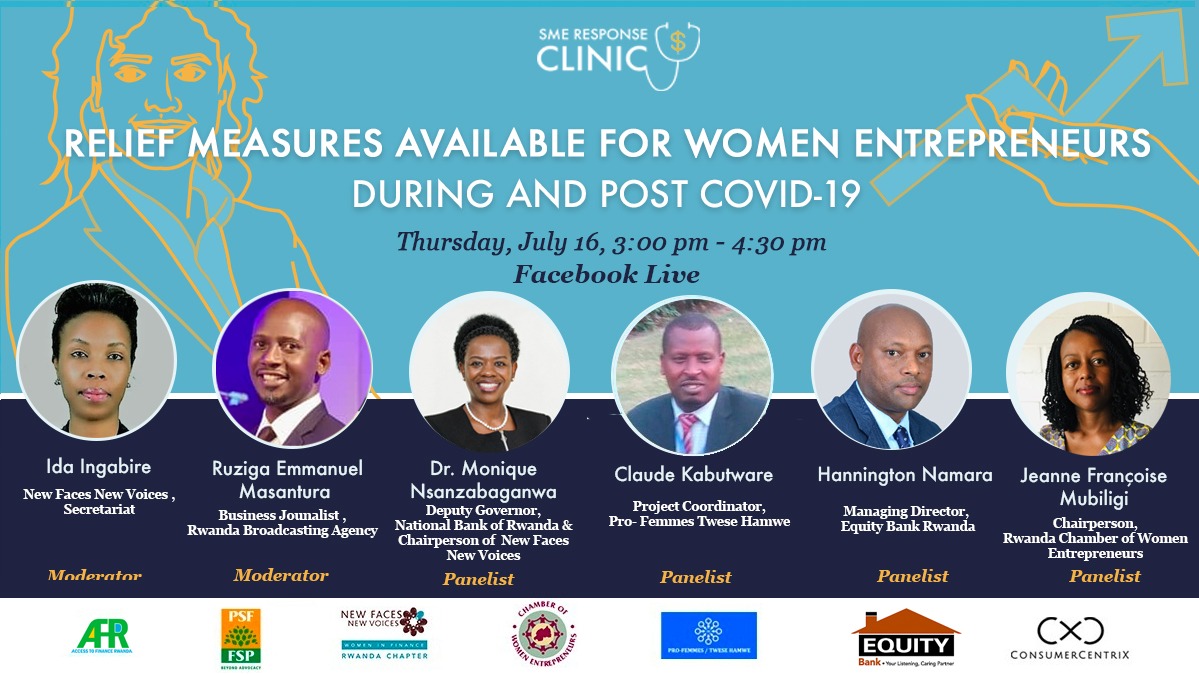
New Faces New Voices Rwanda in collaboration with the SME Response Clinic will be hosting a live discussion focused on how public and private sector measures to address the economic effects of COVID-19 can support women entrepreneurs. The discussion will be hosted on the SME Response Clinic’s Facebook page at 3:00 pm on July 16 and will be held in English and Kinyarwanda.
Micro, small, and medium enterprises (MSMEs) play a significant role in the Rwandan economy and contribute to sustain livelihoods for many. According to the National Institute of Statistics of Rwanda’s Establishment Census 2017, the sector, including private sector and cooperatives, represents 99% of businesses and over 70% of in-establishment employment. Women entrepreneurs are a vital force in Rwanda’s economy. Statistics from the National Gender Policy in Rwanda indicate that women head 42 percent of enterprises and comprise 58 percent of enterprises in the informal sector, which accounts for 30 percent of GDP. National surveys indicate that women entrepreneurs also have a tremendous impact on job creation in Rwanda, with many hiring between 3 and 5 employees to work in their businesses.
In addition to contributing to the development of their local communities through offering employment opportunities, women entrepreneurs contribute substantially to the development of their families through health and nutrition, ensuring funds are available for school fees and higher education for their children, and making improvements to their homes with profits from their businesses. Their contributions, however, are not without challenges. Women entrepreneurs in Rwanda face difficulties in access to three important factors: information, business skills training and development, and finance. They grapple with issues such as high taxes and transportation costs as well as discrimination in property ownership.
As in many markets across the globe, women entrepreneurs in Rwanda have been adversely affected by the COVID-19 pandemic, and measures to contain the spread of the virus have deepened some of the existing challenges they face. In the face of drops in demand or disruptions in the supply chains, a number of jobs have been lost or are at the brink while loans, taxes and rent are going unpaid. To respond to the challenge, the Government of Rwanda introduced the Economic Recovery Fund (ERF) as a mechanism to mitigate the threats that the pandemic is putting on the sector. Due to known barriers women in business face, there is a legitimate concern that without a deliberate effort women-owned/led MSMEs are likely to remain ill-informed and their uptake of ERF less than optimal.
To provide information about ERF and other private and public sector measures available to support women entrepreneurs in these uncertain times, New Faces New Voices Rwanda in collaboration with the SME Response Clinic will be hosting a live discussion focused on how government measures to address the economic effects of COVID-19 can support women entrepreneurs. The discussion will be hosted on the SME Response Clinic’s Facebook page at 3:00 pm on July 16. To increase accessibility for women entrepreneurs, the event will be held mostly in Kinyarwanda.
Panelists include:
Dr. Monique Nsanzabaganwa, Deputy Governor, National Bank of Rwanda
Jeanne Françoise Mubiligi, Chairperson, Rwanda Chamber of Women Entrepreneurs
Claude Kabutware, Project Coordinator, Pro- Femmes Twese Hamwe
Hannington Namara, Managing Director, Equity Bank Rwanda
The panel will be moderated by Ida Ingabire, Secretariat at New Faces, New Voices Rwanda and Ruziga Emmanuel Masantura, Business Journalist, Rwanda Broadcasting Agency.
This discussion will be the first of a two-part conversation with key stakeholders in the Rwandan economy. The second webinar, scheduled for July 30, will focus on how financial services providers are addressing the specific needs of women entrepreneurs in the face of COVID-19.
ConsumerCentriX is a Proud Co-Sponsor of this Event

Supporting Your Business Series: A Discussion with the Microfinance Sector
Supporting Your Business Series
A Discussion with the Microfinance Sector
Join us on Facebook on June 18th for a live discussion with key stakeholders from the microfinance sector!
From 3:00 pm -4:15 pm on Thursday, June 18th, join the SME Response Clinic on Facebook for a live webinar with key stakeholders from the Rwandan microfinance sector hosted by Access to Finance Rwanda and the Association of Microfinance Institutions in Rwanda (AMIR).
You can join simply by opening up the SME Response Clinic page on Facebook at 3pm on June 18th. It will be your chance to learn more about the microfinance sector’s response to support SMEs during the COVID-19 pandemic.
The SME Response Clinic’s goal is to provide more information to SMEs in Rwanda during the pandemic. The Clinic’s partners know that many small businesses are struggling with lack of cash flow, repayment of loans, and an uncertain future right now.
An important part of the response is already coming from the microfinance sector and other institutions. There are products and services in place that are meant to aid with issues of working capital, reduced revenue and liquidity. The key to managing a business and surviving the pandemic will be to stay informed, stay safe, and know what is available to you as a business person – especially if you operate in a hard-hit industry like tourism, hospitality or transport.
During the webinar, you will learn about products and services available from the microfinance sector. You will have the opportunity to ask questions and interact with:
- Jules Théoneste Ndahayo, Chief Executive Officer, UFC PLC and Chairman of the AMIR Board of Directors
- Laurence Uwambaje, Director General, UMWALIMU SACCO
- Grace Dushimimana, Chief Executive Officer, VisionFund Rwanda
- Aimable Nkuranga, Executive Director, Association of Microfinance Institutions in Rwanda
This webinar will be held primarily in English and will be moderated by Frank Baguma, Programs Officer, MFIs & SACCOs Development at Access to Finance Rwanda.
Please join us for this important event!
ConsumerCentriX is a Proud Co-Sponsor of this Event

Re-opening in a Post COVID-19 Environment: Practical Solutions for SMEs
Please note that the webinar will not be accessible until 4:00pm on Tuesday, June 16th
Re-opening in a Post COVID-19 Environment:
Practical Solutions for SMEs
A version of this article was originally posted on the COVID-19 Business Info Hub.
The COVID-19 Business Info Hub is launching a webinar series to provide practical advice and solutions for small and medium enterprises (SMEs) through engaging discussions with expert panelists. The first session, Re-opening in a Post COVID-19 Environment: Practical Solutions for SMEs will be held on Tuesday, June 16th at 4.00 pm. The webinar will provide SMEs and industry stakeholders an opportunity to discuss the ”new normal” and share practical solutions that can help the sector in this time of crisis.
Panelists include Gideon Badagawa, Executive Director of the Private Sector Foundation Uganda (PSFU), Daniel Birungi, Executive Director of Uganda Manufacturers Association (UMA), and Hope Sharon Kwiyocwiny, Sales and Marketing Manager of HMH Rainbow Limited, YO KUKU. The session will be facilitated by Tony Otoa, Executive Director of Stanbic Bank Business Incubator, and hosted on Stanbic Bank Uganda’s Facebook Live page. The session is open to ALL, irrespective of the financial institution you bank with!
The webinar comes at a critical time. Uganda has been on lockdown following the COVID-19 pandemic for close to three months, resulting in a myriad of challenges for SMEs, including disruptions in the supply chain, income loss, and changing work environments. A socio-economic impact assessment of COVID-19 on the formal sector and SMEs by the United Nations Capital Development Fund (UNCDF) conducted in April 2020 reveals that 85 percent of all businesses anticipated financial distress after three months of lockdown. The expectation of loss is at least 90 percent across companies of all sizes.
The plight of SMEs during COVID-19 poses significant challenges to the Ugandan economy. As the engine of growth for economic development, innovation, and wealth creation, SMEs employ over 2.5 million people in Uganda and account for approximately 90 percent of the entire private sector, generating over 80 percent of the manufacturing output that contributes 20 percent of the gross domestic product (GDP).
With this in mind, Stanbic Bank Uganda has deliberately prioritized efforts to support the SME sector in their time of need. In partnership with ConsumerCentrix, Stanbic Bank Uganda has launched the COVID-19 Business Info Hub – a website dedicated to providing useful, practical information on key interventions including business training, useful government directives, and industry interviews to enable SMEs to stay afloat during COVID-19.
We look forward to engaging with you on this relevant discussion towards practical solutions for SMEs.
Sign up for our Newsletter and Event Reminders