

RADIO SHOW | Get to know the Twiteze Imbere Campaign and SME Response Clinic
Get to know the Twiteze Imbere Campaign and SME Response Clinic
On 26th March 2021, the SME Response Clinic launched the Twiteze Imbere campaign to recognize and celebrate the role SMEs play in Rwanda‘s road to recovery from the COVID-19 pandemic. The campaign was supported by the partners of the SME Response Clinic, including the African Management Institute (AMI), which will be providing sponsorship to select runners-up of the campaign’s Business Awards competition to participate in its Survive to Thrive programme. The programme equips business owners with the skills, tools, and strategies to navigate challenges and thrive in difficult times.
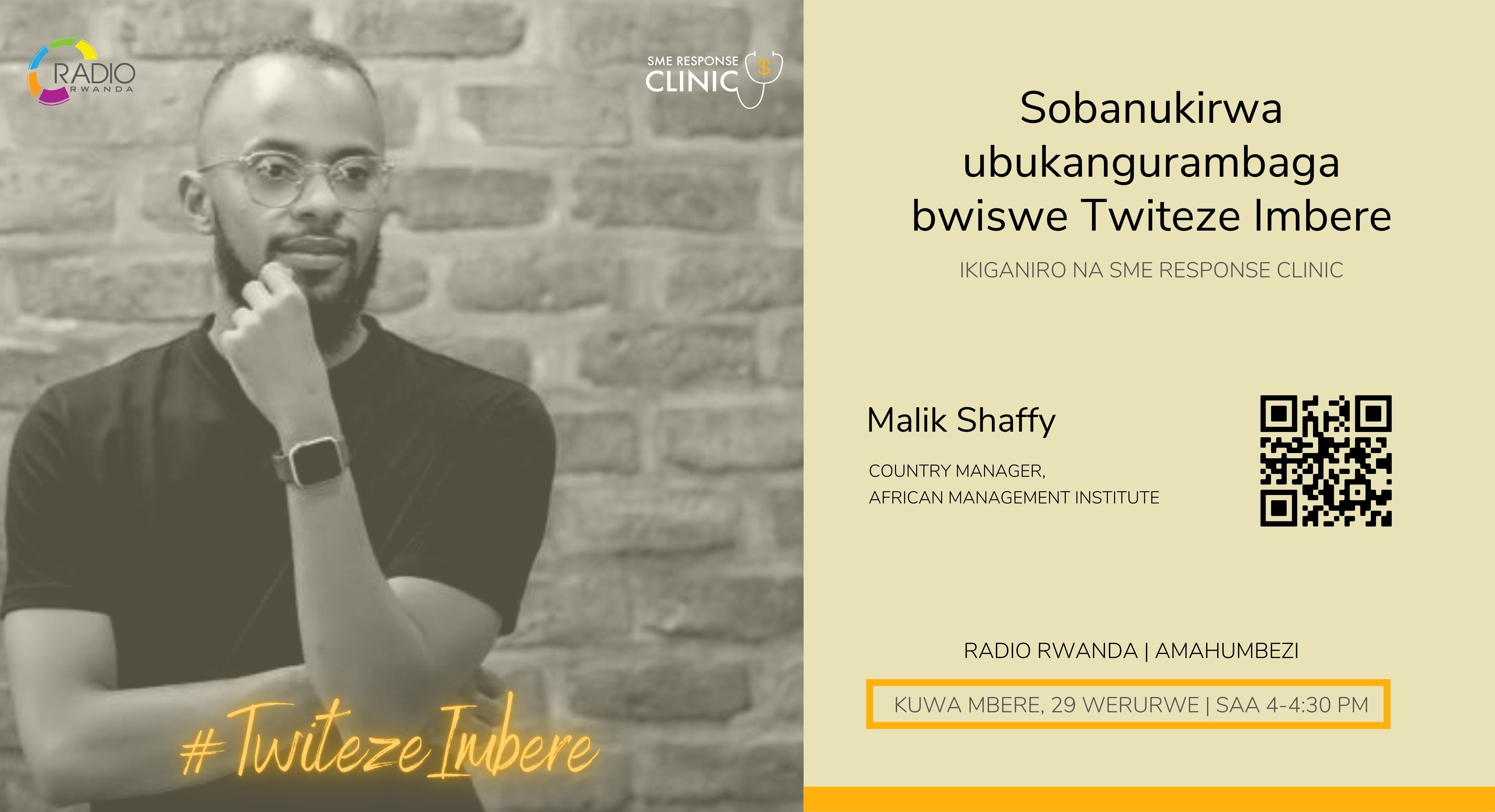
AMI’s country director, Malik Shaffy Lizinde, was featured on Radio Rwanda for a 30-minute discussion on the Amahumbezi program. Malik gave a detailed overview of the campaign and highlighted how SMEs could engage with the campaign to stand a chance to win 1 million Rwandan Francs and expert advisory services.


SME Response Clinic Launches Campaign to Recognise the Role of Small Businesses in Rwanda’s COVID-19 Recovery

Press Release - For Immediate Release
Kigali, Rwanda - 18 March 2021
SME Response Clinic Launches Campaign to Recognise the Role of Small Businesses in Rwanda’s COVID-19 Recovery
A version of this Press Release was originally posted on the SME Response Clinic
The SME Response Clinic, a platform powered by Access to Finance Rwanda and ConsumerCentriX in collaboration with the Private Sector Federation, the Association of Microfinance Institutions in Rwanda, African Management Institute, New Faces New Voices Rwanda, and Rwanda Bankers’ Association, has today launched a campaign to recognise and celebrate the role of small businesses in Rwanda’s road to recovery from the COVID-19 pandemic. The SME Response Clinic is a platform launched in 2020 to support small and medium-sized enterprises to overcome challenges brought about by COVID-19 through resources and learning opportunities.
The three-week campaign is called ‘Twiteze Imbere’ (Let’s Move Forward Together) and will share stories of small business resilience, encourage entrepreneurs and business owners to utilise SME Response Clinic resources, and celebrate exceptional businesses through the inaugural SME Response Clinic Business Awards.
Over the course of the campaign, the general public and other business owners will be invited to nominate their favourite small businesses for a SME Response Clinic Business Award. Nominations are open in the categories of women-owned businesses, start-up or innovative businesses, and established businesses. The winner in each category will receive a cash prize of one million Rwandan francs to invest in their business as well as expert advisory services. Nominations are open from 18 March until 2 April 2021. Selected runners-up will be sponsored to participate in the African Management Institute’s Survive to Thrive programme. Through this programme, business owners will be equipped with the skills, tools, and strategies to navigate challenges and thrive in difficult times, and network with other entrepreneurs in Rwanda and across Africa.
“Small businesses are the backbone of Rwanda’s economy and employ the vast majority of people across the country. The ‘Twiteze Imbere’ campaign celebrates this and recognises their contribution to Rwanda’s recovery from the pandemic. I encourage all Rwandans to nominate their favourite small business for the SME Response Clinic Business Awards as a great way to show support for local business and the role they play in our day-to-day lives,” said Jean Bosco Iyacu, Country Director, Access to Finance Rwanda.
“We’re delighted to launch this campaign to celebrate the tremendous resilience of entrepreneurs in Rwanda. The SME Response Clinic Business Awards are one way we hope to honor and further support the small businesses that have been pillars of the communities during the COVID-19 pandemic,” said Anna Gincherman, Partner, ConsumerCentriX.
Learn more about the campaign and nominate your favourite small business at www.smeresponse.clinic/awards or by calling 0781024420.
About the SME Response Clinic
In May 2020, Access to Finance Rwanda (AFR) partnered with ConsumerCentriX to launch the SME Response Clinic – a platform that supports entrepreneurs in Rwanda struggling in the face of the COVID-19 pandemic. The SME Response Clinic provides access to training, industry insights, and financial management advice to entrepreneurs in Rwanda struggling to adjust to the economic realities of COVID-19. Access the platform at smeresponse.clinic
About Access to Finance Rwanda
AFR began its operations in 2010 with the core objective of stimulating the development of the financial sector in Rwanda. AFR’s intention is to remove the systemic barriers that hinder access to financial services by putting low-income people particularly the rural poor and women at the centre of its interventions. AFR supports the development and provision of financial services including savings, credit, insurance, payments, and remittances. Learn more at afr.rw.
Media Contact
For any enquiries or more information, write to musa.kacheche@consumercentrix.ch or reach out to Emile Ndayambaje, AFR Communications Manager, at emile@afr.rw.

MFW4A webinar: Gender finance as an opportunity during crisis times

MFW4A webinar: Gender finance as an opportunity during crisis times
Alejandra Rios, Partner at ConsumerCentrix, recently participated in a webinar hosted by Making Finance Work for Africa Partnership (MFW4A).This article originally appeared on Platform Africa’s website.
By Erica Yanice B.Essono Nze-Bekale, Darylle Tangara & Karungi Kajura
Women entrepreneurs represent a real opportunity for financial institutions provided they develop products and services as well as a suitable environment to meet their specific needs
Statistics have shown that female entrepreneurship in Africa is the highest in the world at 24 percent compared to 11 percent South East Asia Pacific and 9 percent Europe. It was also noticed that as borrowers, women entrepreneurs repay better than men. However, they face multiple constraints specific to them (household management, interruption of working life due to maternity and illnesses of their children). In addition, they are more vulnerable in times of crisis, but are better able to proactively seek solutions with Financial Institutions in times of crisis.
Addressing this issue, on 4 March 2021, the Making finance Work for Africa Partnership (MFW4A) in collaboration with the IPC, Horus and IECD Consortium hosted a webinar entitled “Gender finance as an opportunity during crisis times”. This session was the last of a series of four (4) webinars dedicated to banks and microfinance institutions in West and Central Africa within the context of the European Investment Bank (EIB) TA Financial sector programme for these regions.
Platform Africa covered the fourth session, and it dealt with topics relating to the financing of entrepreneurship and finance for women as an opportunity in such a crisis. The goal was to help realise the full potential of the African financial sector and stimulate economic development and reduce poverty.
The session was moderated by Edwige Takassi, from IPC GmBH and member of the Women in Africa Network and the three panellists sharing their insights on this topic were: Kady Traoré, Managing Director of Fin’elle of Group Cofina; Alejandra Rios, Partner at ConsumerCentrix and Head of the African Women Rising Initiative (AWRI) funded by the EIB, and Tania Colantone, Social Development Specialist at EIB.


Enhancing your Business Management Skills as Rwanda Reopens for Business
Enhancing your Business Management Skills as Rwanda Reopens for Business
February 18th, 2021, at 3 pm CAT
Join the SME Response Clinic for a live discussion featuring business development services providers in Rwanda. Learn about opportunities to enhance your management skills as Rwanda reopens for business. The discussion will be hosted on the SME Response Clinic’s Facebook page on February 18th at 3 pm CAT and held primarily in Kinyarwanda.
Moderator: Eric Musizana, Agriculture & Rural Finance Project Officer, Access to Finance Rwanda
Panelists:
- Dr. Mukulira Olivier, Managing Director at the Rwanda Institute of Cooperatives, Entrepreneurship, and Microfinance
- Sarah Mukunde, Senior Manager, Westerwelle Startup Haus Kigali
- Malik Shaffy Lizinde, Country Manager, African Management Institute
Please note that the Livestream will not be available until 3 pm CAT on February 18th, 2021

How the Biashara Club transformed Patrick Malika’s network
How the Biashara Club transformed Patrick Malika’s network
In Kenya, it is difficult for potential landowners to purchase small plots of land. As a young entrepreneur interested in real estate, Patrick Malika recognized the gap in the market and started his own company that buys larger plots of lands and then divides that land into smaller plots for resell.
To buy larger parcels of land, he relies heavily on financing from KCB Bank. However as his business expanded, Patrick realized that he needed more than just financing to sustain growth. He needed a strong network. As a result, he joined KCB’s Biashara to club connect with other entrepreneurs. Last January, ConsumerCentriX spoke to Patrick to understand why networking was so important to his business’s success. .

How the SME Response Clinic addresses gender information asymmetries
By Ana Singh, Communication & Marketing Manager at ConsumerCentriX and Ida Ingabire, Secretariat at New Faces, New Voices Rwanda
Investing in women’s entrepreneurship is good for business and essential for socio-economic growth. Women are more likely than men to invest a higher proportion of their income back into their families and communities; yet, most women-owned businesses across Africa remain stagnant at the micro-level, unable to grow.
The reasons holding them back are well-documented. First, women are less likely to access sufficient financing to grow their businesses, greatly hindered by challenges due to information asymmetries that put them at a distinct disadvantage to their male counterparts. In comparison, men are more likely to have access to the right information, training, and guidance to inform their dealings with financial institutions and plan effectively for their businesses in the long-term.
During “business as usual,” information asymmetry makes it challenging for women entrepreneurs to keep up. During a global pandemic, when updates related to financial products or services and government measures are issued multiple times a day, the information gaps can become even more unbalanced – leaving women entrepreneurs even further behind.
In late March, our team recognized the hardship that all entrepreneurs were facing when finding the right COVID19-related information for their businesses. After noticing there was no centralized platform that housed all the crucial updates happening across Rwanda’s private and public sectors, the SME Response Clinic platform was launched to address this gap and support entrepreneurs with relevant information. ConsumerCentriX, in partnership with Access to Finance Rwanda and the Private Sector Federation of Rwanda, created the website.
After reviewing data of the SME Response Clinic platform’s performance from the first few weeks, the team immediately recognized a gender problem when it came to web traffic. Only 30 percent of all visitors were women. Read this article to learn how we closed the gap. Only 30 percent of all visitors were women. Through further examination and analysis, it became apparent that the gender gap in web traffic was a symptom of the gender-neutral content and promotion of the platform on social media.
Recognizing a Problem
As a new platform beginning with zero followers, we relied heavily on an aggressive social media strategy. We launched a Twitter campaign and regularly targeted users on Facebook who exhibited entrepreneurial behavior and interests.
However, this social outreach strategy was not reaching women. For Twitter, a look into the data revealed that a staggering 93 percent of accounts using the campaign’s hashtag were men. While the gender gap on Facebook wasn’t as stark, men were still 73 percent more likely to see an advertisement and 80 percent more likely to engage with the content.
Two possible explanations shed light on our limited initial success in reaching women entrepreneurs in Rwanda. First, women in Rwanda are less likely to have access to phones with the internet and are less likely to be digitally literate than their male counterparts. Web traffic data indicates that roughly 80 percent of the SME Clinic website’s visitors access content through a mobile phone – putting women at a clear disadvantage.
The second barrier was the content itself as there was no particular gender lens in our early articles and videos. Instead, by producing only gender-neutral content, we were exacerbating the existing information asymmetries. We knew that we had to urgently switch up our strategy to reach women entrepreneurs with the right information to support their businesses throughout the economic downturn.
Mobilizing women entrepreneurs to access the right information for their businesses
In this video, Dr. Monique Nsanzabaganwa, Deputy Governor of National Bank of Rwanda and Chairperson of New Faces, New Voices Rwanda, and Ida Ingabire, Secretariat of New Faces New Voices Rwanda, explain the barriers women face when accessing information for their businesses and how SME Response Clinic can bridge that gap.
Developing Content through Partnerships
To create more compelling and meaningful content for women entrepreneurs, the SME Response Clinic partnered with New Faces New Voices Rwanda. From their own experience engaging with women entrepreneurs, New Faces New Voices emphasized the importance of making information available online and the necessity of mobilizing women to access the knowledge through a personal touch.
Though the partnership with New Faces New Voices, the SME Response Clinic delivered new content specifically for women entrepreneurs. Once finalized, we promoted on Facebook, specifically targeting women users who exhibited entrepreneurial interests.
However, to be seen as a platform that women could trust required a more involved personal touch. We decided to produce a Facebook event specifically for women entrepreneurs. The event allowed women entrepreneurs to ask high-level government officials, including Dr. Monique Nsanzabaganwa, a Deputy Governor of the National Bank of Rwanda, and private sector leaders about new government measures in place to support their business survival and growth.
While previous events hosted by the SME Response Clinic were held in English, the decision was made to have the conversation in Kinyarwanda at New Faces New Voices’ recommendation. By using the native dialect of Rwanda, there was a shared goal to make the event more accessible for women entrepreneurs, particularly those at the micro-level.
To increase attendance, New Faces New Voices reached out directly to their member through phone calls, bulk SMS, email and WhatsApp group messages. This outreach effort then turned into technical assistance support during the event, as staff helped users who were having issues accessing the live stream video. In the end, the panelists’ star power and the hard work of the organizers paid off. Even though only women received promotions for the event, the total number of users who viewed the live session outnumbered the turnout of our previous events on Facebook Live.
Final Thoughts
The event’s success meant that for the first time since the launch of the website, we were able to achieve gender parity in our weekly visitors. In the weeks and months following the event, we have learned that we can continue to achieve parity in weekly visitors if we publish content and produce events specifically for women. If we do not publish this targeted content, the gender gap returns without fail. While this overall shift in strategy requires more work and depends on successful external partnerships, women entrepreneurs’ benefits are too significant to ignore. In the coming months, the SME Response Clinic will continue to engage women entrepreneurs with events and relevant content for their businesses.

AMI Online Bootcamp: Tools for Managing Risk and Learning from Others - Mathew Rwahigi
AMI ONLINE BUSINESS BOOTCAMP
Matthew Rwahigi, Owner of Thella Café
The SME Response Clinic is a digital platform powered by ConsumerCentriX, Access to Finance Rwanda, and Rwanda Private Sector Federation to support small and medium enterprises in Rwanda struggling to adjust to the economic realities of COVID-19. To provide much-needed training opportunities for the entrepreneurs, the SME Response Clinic joined forces with the African Management Institute.
Testimonial: Matthew Rwahigi, Owner, Thella Café – Saturday May 30, 2020
Matthew Rwahigi, a small business owner in Gisozi, was hit hard when the COVID-19 lockdowns began in Kigali. Luckily, as a participant in AMI’s trainings for small businesses, he learned the skills to negotiate with suppliers and his landlords and to make the tough decisions needed to help his business survive.
“The conversations and hearing from other colleagues through the AMI workshops, you feel like you’re not alone. At first I thought maybe I was in the wrong business, this was a bad idea, I just burnt my savings for no good reasons. But then you hear other people and you feel that you are in this with so many others. It gives you the strength to stay the course and find the resources to manage.”
What was most valuable for you about the AMI trainings?
First, I learned to focus on learning how to manage a business. I got to focus a bit on my business. Since I Getting to focus a bit – I hadn’t done business in the past, I did not have the tools and skills to plan and make tough decisions, like having to lay off staff.
Second, I benefited from networking and finding out what other people are going through. I learned a lot from this. I really value the community of business people and their input, because if my business is going to survive, I need these relationships. Now at least I have some knowledge, and if my business doesn’t survive, and if I started another business I would be better informed, and more empowered.
How has AMI supported you?
AMI is there when you need to ask a question, to give you tips and ideas. There is an online business portal with tools and courses, and these are important in continuing to build skills.
“The AMI group really helped us in empowering us to feel that this is not the end of the road, to have a feeling that yes, there is a pandemic but you can still try to tune your business up a bit to survive the pandemic, and even have an opportunity to continue after the pandemic.”


AMI Online Bootcamp: Tools for Managing Risk and Learning from Others - Yannick
AMI ONLINE BUSINESS BOOTCAMP
Yannick Tuyishime, CEO and co-founder of Tsapal Company Ltd
The SME Response Clinic is a digital platform powered by ConsumerCentriX, Access to Finance Rwanda, and Rwanda Private Sector Federation to support small and medium enterprises in Rwanda struggling to adjust to the economic realities of COVID-19. To provide much-needed training opportunities for the entrepreneurs, the SME Response Clinic joined forces with the African Management Institute.
Testimonial: Yannick Tuyishime, CEO and co-founder of Tsapal Company Ltd
Yannick Tuyishime is the CEO and co-founder of Tsapal Company Ltd, a footwear and apparel manufacturing company since late 2019. The company was brand new when the COVID-19 pandemic hit, but participating in the AMI Bootcamphelped to keep business afloat during crisis.
“When we came up with the idea for our company, we saw that there are many problems in the community that we can do something about. The first is that there are high rates of unemployment in Rwanda and in Africa. The other is that we see that we can do something that can do boost Made in Rwanda products. Import taxes are high in Rwanda, and so by increasing Made in Rwanda products we can fill the gap by bringing prices down and manufacturing locally.”
With the AMI Bootcamp, Yannick learned how to better manage cashflow, negotiate with his landlord, improve communications between staff and with customers, and assess and plan for risks. This allowed him to receive a reduction on rent during the worst part of the lockdown, as well as to keep all staff employed by making some salary reductions as well as cutting down on unnecessary costs. The company even reduced some of the product prices so as to keep customers on board and not lose them during the pandemic.
Yannick encourages other Rwandan entrepreneurs to attend AMI’s courses and upcoming Bootcamps so that they too can benefit from the toolkit and learn to manage risks, negotiate with customers and suppliers, and bring larger visions to fruition while dealing with today’s challenges.
“I appreciate the AMI Bootcamp because now I record weekly all of our expenses in the business and use the project management plan. The other thing is that I’ve learned how to assess some risks – like in this time, what I’ve learned from AMI bootcamp is that I can sit down and see what is not going well, what is going well, in cash management. I can make an action plan to meet the risks that I’ve assessed. Wholeheartedly, I can’t thank AMI enough and I encourage everyone to attend AMI Bootcamps and for those who have already attended to take some of the other courses that they provide. When someone wants to grow a business sustainably the AMI bootcamp will really help.”
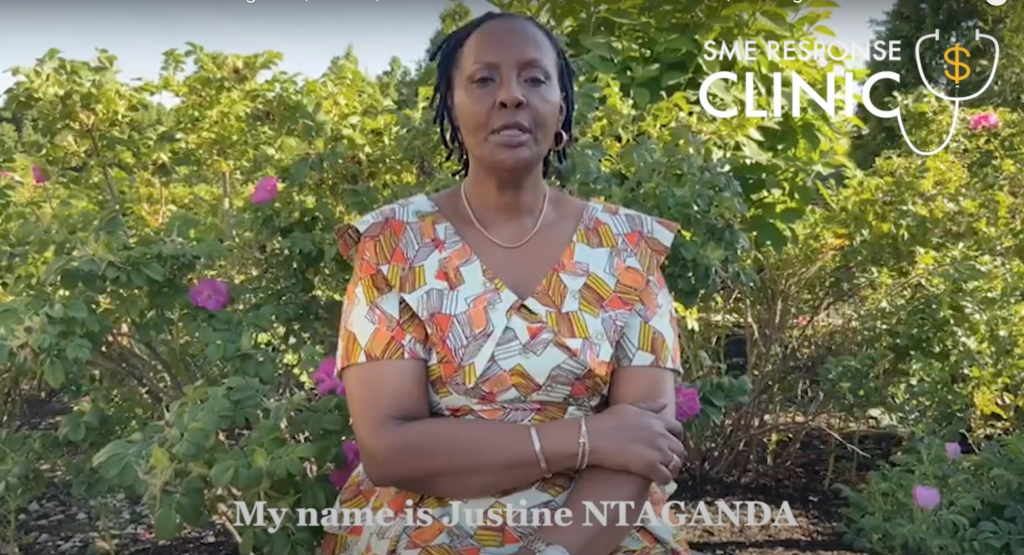
AMI Online Bootcamp: Tools for Managing Risk and Learning from Others - Justine Ntaganda
AMI ONLINE BUSINESS BOOTCAMP
Justine Ntaganda, Owner, La Corniche Hotel
The SME Response Clinic is a digital platform powered by ConsumerCentriX, Access to Finance Rwanda, and Rwanda Private Sector Federation to support small and medium enterprises in Rwanda struggling to adjust to the economic realities of COVID-19. To provide much-needed training opportunities for the entrepreneurs, the SME Response Clinic joined forces with the African Management Institute.
Testimonial: Justine Ntaganda, Owner, La Corniche Hotel in Rubavu and Nyabihu, and Salma Nkusi, Manager (it is a family business)
Justine Ntaganda and Salma Nkusi operate the “La Corniche” hotels in two locations in Rwanda, Rubavu and Nyabihu. The hospitality and tourism industry has been hard-hit by the COVID-19 pandemic and the mother-daughter team has found that the AMI trainings have provided an opportunity to take a step back, learn new business skills, and make decisions that will help the hotels to thrive in the future.
What was most valuable for you about the AMI trainings?
“My daughter Salma and I have benefited enormously from the tools shared by AMI. For me personally, the advice shared on tools for better collaboration helped us to choose to use “One Drive” to share information. The tool for analyzing clients’ needs was also an interesting exercise during this time because demand has changed a lot. It is important that we adapt and continue to do our business.” ~ Justine Ntaganda
With the AMI tools, we are now able to check our books on a weekly basis, track cashflow and be accountable. Now, we even have a meeting on a weekly basis with our staff using the data and make decisions about where we stand. Where do we need to cut, for example?
These tools are helping with day-to-day management and the trainings have provided content in an understandable way. What’s more, the session on goal setting has been very great. Now as a team we talk and think together about our long-term goals and put them in writing as well. This helps us to prioritize and to decide how we will track our progress together.
“AMI is pushing me towards the implementation of all of these new ideas that I had but weren’t written down, and didn’t have a timeline –the tools are great, and looking at budgeting of the organization is something that we need to have in place for banks in terms of funding, too.” ~ Salma Nkusi
How has AMI supported you?
For us, it has been like going back to school, only for our personal growth and for the benefit of our business. AMI has helped us create a budget, and not only that, but to learn how to communicate with our staff so that they clearly see that there are reasons that we make the financial decisions we need to make.
One other interesting area of support from AMI is their “A New Rise” daily meditation. It’s another way to start your day by clearing your mind, breathing, and planning instead of waking up and feeling as if you are just facing emergencies.

VIDEO | Introducing the COVID-19 Business Information Hub
Introducing the COVID-19 Business Information Hub
To provide the much-needed information and solutions for Ugandan entrepreneurs struggling with the financial consequences of the pandemic, Stanbic Bank has partnered with ConsumerCentriX on the Covid-19 Business Info Hub.